


Get Perfect Results with Premium DP-300 Dumps Updated 284 Questions
Free DP-300 Exam Study Guide for the NEW Dumps Test Engine
NEW QUESTION # 111
You have an Azure SQL managed instance named SQLMI1 that has Resource Governor enabled and is used by two apps named App1 and App2.
You need to configure SQLMI1 to limit the CPU and memory resources that can be allocated to App1.
Which four actions should you perform in sequence? To answer, move the appropriate actions from the list of actions to the answer area and arrange them in the correct order.
Answer:
Explanation:
1 - Create a resource pool.
2 - Create a workload group.
3 - Create a user-defined classifier function.
4 - Modify Resources Governor.
Reference:
https://docs.microsoft.com/en-us/sql/relational-databases/resource-governor/resource-governor?view=sql-server-ver15
https://docs.microsoft.com/en-us/sql/relational-databases/resource-governor/create-and-test-a-classifier-user-defined-function?view=sql-server-ver15
NEW QUESTION # 112
You are performing exploratory analysis of bus fare data in an Azure Data Lake Storage Gen2 account by using an Azure Synapse Analytics serverless SQL pool.
You execute the Transact-SQL query shown in the following exhibit.
Use the drop-down menus to select the answer choice that completes each statement based on the information presented in the graphic.
Answer:
Explanation:
Reference:
https://docs.microsoft.com/en-us/azure/synapse-analytics/sql/develop-openrowset
NEW QUESTION # 113
You have an Azure SQL database.
You are reviewing a slow performing query as shown in the following exhibit.
Use the drop-down menus to select the answer choice that completes each statement based on the information presented in the graphic.
NOTE: Each correct selection is worth one point.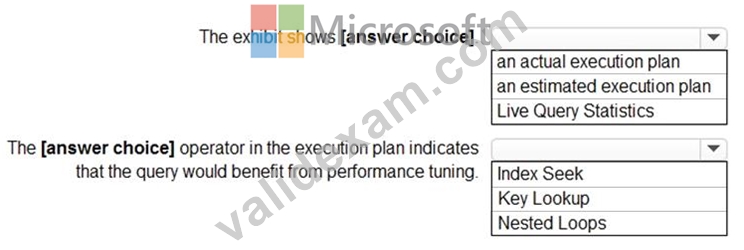
Answer:
Explanation:
Reference:
https://docs.microsoft.com/en-us/sql/relational-databases/performance/live-query-statistics?view=sql-server-ver15
NEW QUESTION # 114
You have an Azure SQL database named DB 1 in the General Purpose service tier.
You need to monitor DB 1 by using SQL Insights.
What should you include in the solution? To answer, select the appropriate options in the answer area.
NOTE: Each correct selection is worth one point.
Answer:
Explanation:
Explanation
Box 1 = Azure Monitor Agent
Box 2 = An Azure SQL database
https://docs.microsoft.com/en-us/azure/azure-sql/database/sql-database-paas-overview?view=azuresql
NEW QUESTION # 115
You are provisioning an Azure SQL database in the Azure portal as shown in the following exhibit.
Use the drop-down menus to select the answer choice that completes each statement based on the information presented in the graphic.
NOTE: Each correct selection is worth one point.
Answer:
Explanation:
Explanation
Graphical user interface, text, application, email Description automatically generated
Reference:
https://docs.microsoft.com/en-us/azure/azure-sql/database/serverless-tier-overview
NEW QUESTION # 116
What should you do after a failover of SalesSQLDb1 to ensure that the database remains accessible to SalesSQLDb1App1?
- A. Configure SalesSQLDb1 as writable.
- B. Update the firewall rules of SalesSQLDb1.
- C. Update the connection strings of SalesSQLDb1App1.
- D. Update the users in SalesSQLDb1.
Answer: B
Explanation:
Scenario: SalesSQLDb1 uses database firewall rules and contained database users.
Topic 2, Contoso Ltd
To start the case study
To display the first question in this case study, click the Next button. Use the buttons in the left pane to explore the content of the case study before you answer the questions. Clicking these buttons displays information such as business requirements, existing environment, and problem statements. If the case study has an All Information tab, note that the information displayed is identical to the information displayed on the subsequent tabs. When you are ready to answer a question, click the Question button to return to the question.
Overview
Existing Environment
Contoso, Ltd. is a financial data company that has 100 employees. The company delivers financial data to customers.
Active Directory
Contoso has a hybrid Azure Active Directory (Azure AD) deployment that syncs to on-premises Active Directory.
Database Environment
Contoso has SQL Server 2017 on Azure virtual machines shown in the following table.
SQL1 and SQL2 are in an Always On availability group and are actively queried. SQL3 runs jobs, provides historical data, and handles the delivery of data to customers.
The on-premises datacenter contains a PostgreSQL server that has a 50-TB database.
Current Business Model
Contoso uses Microsoft SQL Server Integration Services (SSIS) to create flat files for customers. The customers receive the files by using FTP.
Requirements
Planned Changes
Contoso plans to move to a model in which they deliver data to customer databases that run as platform as a service (PaaS) offerings. When a customer establishes a service agreement with Contoso, a separate resource group that contains an Azure SQL database will be provisioned for the customer. The database will have a complete copy of the financial data. The data to which each customer will have access will depend on the service agreement tier. The customers can change tiers by changing their service agreement.
The estimated size of each PaaS database is 1 TB.
Contoso plans to implement the following changes:
Business Goals
Contoso identifies the following business requirements:
Technical Requirements
Contoso identifies the following technical requirements:
Monitoring Requirements
Contoso identifies the following monitoring requirements:
PaaS Prototype
During prototyping of the PaaS solution in Azure, you record the compute utilization of a customer's Azure SQL database as shown in the following exhibit.
Role Assignments
For each customer's Azure SQL Database server, you plan to assign the roles shown in the following exhibit.
NEW QUESTION # 117
You need to implement the surrogate key for the retail store table. The solution must meet the sales transaction dataset requirements.
What should you create?
- A. a table that has a FOREIGN KEY constraint
- B. a table the has an IDENTITY property
- C. a user-defined SEQUENCE object
- D. a system-versioned temporal table
Answer: B
Explanation:
Explanation
Scenario: Contoso requirements for the sales transaction dataset include:
Implement a surrogate key to account for changes to the retail store addresses.
A surrogate key on a table is a column with a unique identifier for each row. The key is not generated from the table data. Data modelers like to create surrogate keys on their tables when they design data warehouse models. You can use the IDENTITY property to achieve this goal simply and effectively without affecting load performance.
Reference:
https://docs.microsoft.com/en-us/azure/synapse-analytics/sql-data-warehouse/sql-data-warehouse-tablesidentity
NEW QUESTION # 118
You have an Azure Data Lake Storage Gen2 account named account1 that stores logs as shown in the following table.
You do not expect that the logs will be accessed during the retention periods.
You need to recommend a solution for account1 that meets the following requirements:
Automatically deletes the logs at the end of each retention period
Minimizes storage costs
What should you include in the recommendation? To answer, select the appropriate options in the answer area.
NOTE: Each correct selection is worth one point.
Answer:
Explanation:
Reference:
https://docs.microsoft.com/en-us/azure/storage/blobs/storage-blob-storage-tiers
NEW QUESTION # 119
You are building an Azure Stream Analytics job to retrieve game data.
You need to ensure that the job returns the highest scoring record for each five-minute time interval of each game.
How should you complete the Stream Analytics query? To answer, select the appropriate options in the answer area.
NOTE: Each correct selection is worth one point.
Answer:
Explanation:
Explanation
Graphical user interface, text, application, email Description automatically generated
Box 1: TopOne() OVER(PARTITION BY Game ORDER BY Score Desc)
TopOne returns the top-rank record, where rank defines the ranking position of the event in the window according to the specified ordering. Ordering/ranking is based on event columns and can be specified in ORDER BY clause.
Analytic Function Syntax:
TopOne() OVER ([<PARTITION BY clause>] ORDER BY (<column name> [ASC |DESC])+ <LIMIT DURATION clause> [<WHEN clause>]) Box 2: Tumbling(minute 5) Tumbling window functions are used to segment a data stream into distinct time segments and perform a function against them, such as the example below. The key differentiators of a Tumbling window are that they repeat, do not overlap, and an event cannot belong to more than one tumbling window.
Reference:
https://docs.microsoft.com/en-us/stream-analytics-query/topone-azure-stream-analytics
https://github.com/MicrosoftDocs/azure-docs/blob/master/articles/stream-analytics/stream-analytics-window-fun
NEW QUESTION # 120
You are building an Azure Stream Analytics job to retrieve game data.
You need to ensure that the job returns the highest scoring record for each five-minute time interval of each game.
How should you complete the Stream Analytics query? To answer, select the appropriate options in the answer area.
NOTE:Each correct selection is worth one point.
Answer:
Explanation:
Explanation
Graphical user interface, text, application, email Description automatically generated
Box 1: TopOne() OVER(PARTITION BY Game ORDER BY Score Desc)
TopOne returns the top-rank record, where rank defines the ranking position of the event in the window according to the specified ordering. Ordering/ranking is based on event columns and can be specified in ORDER BY clause.
Analytic Function Syntax:
TopOne() OVER ([<PARTITION BY clause>] ORDER BY (<column name> [ASC |DESC])+ <LIMIT DURATION clause> [<WHEN clause>]) Box 2: Tumbling(minute 5) Tumbling window functions are used to segment a data stream into distinct time segments and perform a function against them, such as the example below. The key differentiators of a Tumbling window are that they repeat, do not overlap, and an event cannot belong to more than one tumbling window.
Reference:
https://docs.microsoft.com/en-us/stream-analytics-query/topone-azure-stream-analytics
https://github.com/MicrosoftDocs/azure-docs/blob/master/articles/stream-analytics/stream-analytics-window-fun
NEW QUESTION # 121
DRAG DROP
You need to implement statistics maintenance for SalesSQLDb1. The solution must meet the technical requirements.
Which four actions should you perform in sequence? To answer, move the appropriate actions from the list of actions to the answer area and arrange them in the correct order.
Select and Place:
Answer:
Explanation:
Section: [none]
Explanation:
Automating Azure SQL DB index and statistics maintenance using Azure Automation:
1. Create Azure automation account (Step 1)
2. Import SQLServer module (Step 2)
3. Add Credentials to access SQL DB
This will use secure way to hold login name and password that will be used to access Azure SQL DB
4. Add a runbook to run the maintenance (Step 3)
Steps:
1. Click on "runbooks" at the left panel and then click "add a runbook"
2. Choose "create a new runbook" and then give it a name and choose "Powershell" as the type of the runbook and then click on "create"
5. Schedule task (Step 4)
Steps:
1. Click on Schedules
2. Click on "Add a schedule" and follow the instructions to choose existing schedule or create a new schedule.
Reference:
https://techcommunity.microsoft.com/t5/azure-database-support-blog/automating-azure-sql-db-index-and- statistics-maintenance-using/ba-p/368974 Question Set 2
NEW QUESTION # 122
You have an Azure SQL database named db1 on a server named server1.
You need to modify the MAXDOP settings for db1.
What should you do?
- A. Configure the extended properties of db1.
- B. Modify the database scoped configuration of db1.
- C. Connect to the master database of server1 and run the sp_configure command.
- D. Connect to db1 and run the sp_configure command.
Answer: B
Explanation:
Reference:
https://docs.microsoft.com/en-us/azure/azure-sql/database/configure-max-degree-of-parallelism
NEW QUESTION # 123
You have an Azure SQL database named sqldb1.
You need to minimize the amount of space by the data and log files of sqldb1.
What should you run?
- A. DBCC SHRINKDATABASE
- B. sp_clean_db_free_space
- C. DBCC SHRINKFILE
- D. sp_clean_db_file_free_space
Answer: C
Explanation:
Explanation
DBCC SHRINKDATABASE shrinks the size of the data and log files in the specified database.
Reference:
https://docs.microsoft.com/en-us/sql/t-sql/database-console-commands/dbcc-shrinkdatabase-transact-sql
NEW QUESTION # 124
You have an Azure subscription.
You need to deploy an Azure SQL managed instance by using an Azure Resource Manager (ARM) template.
The solution must meet the following requirements:
The SQL managed instance must be assigned a unique identity.
The SQL managed instance must be available in the event of an Azure datacenter outage.
How should you complete the template? To answer, drag the appropriate values to the correct targets. Each value may be used once, more than once, or not at all. You may need to drag the split bar between panes or scroll to view content.
NOTE: Each correct selection is worth one point.
Answer:
Explanation:
Explanation
NEW QUESTION # 125
You need to recommend a configuration for ManufacturingSQLDb1 after the migration to Azure. The solution must meet the business requirements.
What should you include in the recommendation? To answer, select the appropriate options in the answer area.
NOTE: Each correct selection is worth one point.
Answer:
Explanation: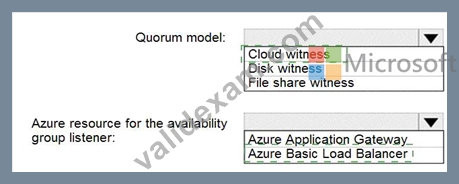
Explanation
Scenario: Business Requirements
Litware identifies business requirements include: meet an SLA of 99.99% availability for all Azure deployments.
Box 1: Cloud witness
If you have a Failover Cluster deployment, where all nodes can reach the internet (by extension of Azure), it is recommended that you configure a Cloud Witness as your quorum witness resource.
Box 2: Azure Basic Load Balancer
Microsoft guarantees that a Load Balanced Endpoint using Azure Standard Load Balancer, serving two or more Healthy Virtual Machine Instances, will be available 99.99% of the time.
Note: There are two main options for setting up your listener: external (public) or internal. The external (public) listener uses an internet facing load balancer and is associated with a public Virtual IP (VIP) that is accessible over the internet. An internal listener uses an internal load balancer and only supports clients within the same Virtual Network.
Reference:
https://technet.microsoft.com/windows-server-docs/failover-clustering/deploy-cloud-witness
https://azure.microsoft.com/en-us/support/legal/sla/load-balancer/v1_0/
NEW QUESTION # 126
You plan to develop a dataset named Purchases by using Azure Databricks. Purchases will contain the following columns:
* ProductID
* ItemPrice
* LineTotal
* Quantity
* StoreID
* Minute
* Month
* Hour
* Year
* Day
You need to store the data to support hourly incremental load pipelines that will vary for each StoreID. The solution must minimize storage costs.
How should you complete the code? To answer, select the appropriate options in the answer area.
NOTE: Each correct selection is worth one point.
Answer:
Explanation:
Explanation
Graphical user interface, text, application Description automatically generated
Box 1: .partitionBy
Example:
df.write.partitionBy("y","m","d")
mode(SaveMode.Append)
parquet("/data/hive/warehouse/db_name.db/" + tableName)
Box 2: ("Year","Month","Day","Hour","StoreID")
Box 3: .parquet("/Purchases")
Reference:
https://intellipaat.com/community/11744/how-to-partition-and-write-dataframe-in-spark-without-deleting-partitio
NEW QUESTION # 127
You have an Azure Synapse Analytics dedicated SQL pool named Pool1 and an Azure Data Lake Storage Gen2 account named Account1.
You plan to access the files in Account1 by using an external table.
You need to create a data source in Pool1 that you can reference when you create the external table.
How should you complete the Transact-SQL statement? To answer, select the appropriate options in the answer area.
NOTE: Each correct selection is worth one point.
Answer:
Explanation:
Explanation
Graphical user interface, table Description automatically generated
Box 1: blob
The following example creates an external data source for Azure Data Lake Gen2 CREATE EXTERNAL DATA SOURCE YellowTaxi WITH ( LOCATION = 'https://azureopendatastorage.blob.core.windows.net/nyctlc/yellow/', TYPE = HADOOP) Box 2: HADOOP Reference:
https://docs.microsoft.com/en-us/azure/synapse-analytics/sql/develop-tables-external-tables
NEW QUESTION # 128
Which windowing function should you use to perform the streaming aggregation of the sales data?
- A. Sliding
- B. Hopping
- C. Tumbling
- D. Session
Answer: C
Explanation:
Section: [none]
Explanation:
Scenario: The sales data, including the documents in JSON format, must be gathered as it arrives and analyzed online by using Azure Stream Analytics. The analytics process will perform aggregations that must be done continuously, without gaps, and without overlapping.
Tumbling window functions are used to segment a data stream into distinct time segments and perform a function against them, such as the example below. The key differentiators of a Tumbling window are that they repeat, do not overlap, and an event cannot belong to more than one tumbling window.
Reference:
https://github.com/MicrosoftDocs/azure-docs/blob/master/articles/stream-analytics/stream-analytics-window- functions.md
NEW QUESTION # 129
You have an on-premises Microsoft SQL Server 2016 server named Server1 that contains a database named DB1.
You need to perform an online migration of DB1 to an Azure SQL Database managed instance by using Azure Database Migration Service.
How should you configure the backup of DB1? To answer, select the appropriate options in the answer area.
NOTE: Each correct selection is worth one point.
Answer:
Explanation:
Reference:
https://docs.microsoft.com/en-us/azure/dms/known-issues-azure-sql-db-managed-instance-online
NEW QUESTION # 130
You have an Azure SQL Database server named sqlsrv1 that hosts 10 Azure SQL databases.
The databases perform slower than expected.
You need to identify whether the performance issue relates to the use of tempdb on sqlsrv1.
What should you do?
- A. Run dynamic management view-based queries
- B. Review information provided by SQL Server Profiler-based traces
- C. Run Query Store-based queries
- D. Review information provided by Query Performance Insight
Answer: A
Explanation:
The diagnostics log outputs tempDB contention details. You can use the information as the starting point for troubleshooting.
You can use the Intelligent Insights performance diagnostics log of Azure SQL Database to troubleshoot performance issues.
Reference:
https://docs.microsoft.com/en-us/azure/azure-sql/database/intelligent-insights-troubleshoot-performance#tempdb-contention
https://docs.microsoft.com/en-us/azure/azure-sql/database/intelligent-insights-use-diagnostics-log
NEW QUESTION # 131
You have the following Azure Resource Manager template.
For each of the following statements, select Yes if the statement is true. Otherwise, select No.
NOTE: Each correct selection is worth one point.
Answer:
Explanation:
Reference:
https://docs.microsoft.com/en-us/azure/azure-sql/database/purchasing-models
https://docs.microsoft.com/en-us/azure/azure-sql/database/single-database-create-arm-template-quickstart
NEW QUESTION # 132
You plan to migrate on-premises Microsoft SQL Server databases to Azure.
You need to identify which deployment and resiliency options meet the following requirements:
Support user-initiated backups.
Support multiple automatically replicated instances across Azure regions.
Minimize administrative effort to implement and maintain business continuity.
What should you identify? To answer, select the appropriate options in the answer area.
NOTE: Each correct selection is worth one point.
Answer:
Explanation:
Reference:
https://docs.microsoft.com/en-us/azure/azure-sql/virtual-machines/windows/sql-server-on-azure-vm-iaas-what-is-overview
https://docs.microsoft.com/en-us/dotnet/architecture/cloud-native/infrastructure-resiliency-azure
NEW QUESTION # 133
Based on the PaaS prototype, which Azure SQL Database compute tier should you use?
- A. General Purpose v-vCore
- B. Business Critical 4-vCore
- C. Hyperscale
- D. Serverless
Answer: B
Explanation:
There are CPU and Data I/O spikes for the PaaS prototype. Business Critical 4-vCore is needed.
Reference:
https://docs.microsoft.com/en-us/azure/azure-sql/database/reserved-capacity-overview
Topic 1, Contoso Ltd
Existing Environment
Contoso, Ltd. is a financial data company that has 100 employees. The company delivers financial data to customers.
Active Directory
Contoso has a hybrid Azure Active Directory (Azure AD) deployment that syncs to on-premises Active Directory.
Database Environment
Contoso has SQL Server 2017 on Azure virtual machines shown in the following table.
SQL1 and SQL2 are in an Always On availability group and are actively queried. SQL3 runs jobs, provides historical data, and handles the delivery of data to customers.
The on-premises datacenter contains a PostgreSQL server that has a 50-TB database.
Current Business Model
Contoso uses Microsoft SQL Server Integration Services (SSIS) to create flat files for customers. The customers receive the files by using FTP.
Requirements
Planned Changes
Contoso plans to move to a model in which they deliver data to customer databases that run as platform as a service (PaaS) offerings. When a customer establishes a service agreement with Contoso, a separate resource group that contains an Azure SQL database will be provisioned for the customer. The database will have a complete copy of the financial data. The data to which each customer will have access will depend on the service agreement tier. The customers can change tiers by changing their service agreement.
The estimated size of each PaaS database is 1 TB.
Contoso plans to implement the following changes:
Business Goals
Contoso identifies the following business requirements:
Technical Requirements
Contoso identifies the following technical requirements:
Monitoring Requirements
Contoso identifies the following monitoring requirements:
PaaS Prototype
During prototyping of the PaaS solution in Azure, you record the compute utilization of a customer's Azure SQL database as shown in the following exhibit.
Role Assignments
For each customer's Azure SQL Database server, you plan to assign the roles shown in the following exhibit.
NEW QUESTION # 134
......
DP-300 PDF Dumps Extremely Quick Way Of Preparation: https://www.validexam.com/DP-300-latest-dumps.html
Download DP-300 Dumps (2023) - Free PDF Exam Demo: https://drive.google.com/open?id=12M_RPe3IIZX8-VzTrNJQULQsM8_uFnAt