


DP-300 Exam Dumps Pass with Updated Oct-2026 Tests Dumps
DP-300 exam questions for practice in 2026 Updated 503 Questions
Microsoft DP-300 certification exam is a valuable credential for IT professionals who want to demonstrate their expertise in administering relational databases on Microsoft Azure. Administering Relational Databases on Microsoft Azure certification covers a wide range of topics related to database administration and is ideal for individuals who are already working with databases and want to enhance their skills in managing them on Azure. With the increased job opportunities and higher salaries that come with earning this certification, it is definitely worth considering for IT professionals looking to advance their careers.
NEW QUESTION # 70
You have an Azure subscription.
You need to deploy a new Azure SQL database by using Azure Command-Line Interface (CLI).
Which three parameters are required?
- A.

- B.

- C.

- D.

Answer: B
NEW QUESTION # 71
Drag and Drop Question
You have an Azure subscription that contains an Azure SQL database named SQLDb1. SQLDb1 contains a table named Table1.
You plan to deploy an Azure web app named webapp1 that will export the rows in Table1 that have changed.
You need to ensure that webapp1 can identify the changes to Table1. The solution must meet the following requirements:
- Minimize compute times.
- Minimize storage.
Which three actions should you perform in sequence? To answer, move the appropriate actions from the list of actions to the answer area and arrange them in the correct order.
Answer:
Explanation:
Explanation:
https://learn.microsoft.com/en-us/sql/relational-databases/track-changes/about-change-tracking- sql-server?view=sql-server-ver16 To track changes, change tracking must first be enabled for the database and then enabled for the tables that you want to track within that database. The table definition does not have to be changed in any way, and no triggers are created.
NEW QUESTION # 72
You have an instance of SQL Server on Azure Virtual Machines named VM1.
You need to implement a disaster recovery solution that meets the following requirements:
- Returns the solution to an operational state within 15 minutes of a
failure
- Can perform disaster recovery testing in an isolated environment
- Minimizes administrative effort
What should you include in the solution?
- A. a failover cluster instance (FCI)
- B. active geo-replication
- C. Azure Site Recovery
- D. auto-failover groups
Answer: C
Explanation:
Replication with Azure Site Recover:
- RTO is typically less than 15 minutes.
- RPO: One hour for application consistency and five minutes for crash consistency.
Always On availability group RPO: Because replication to the secondary replica is asynchronous, there's some data loss.
Reference:
https://docs.microsoft.com/en-us/azure/site-recovery/site-recovery-sql
NEW QUESTION # 73
You have an Azure subscription that contains the resources shown in the following table.
You need to create a read-only replica of DB1 and configure the App1 instances to use the replica.
What should you do? To answer, select the appropriate options in the answer area.
NOTE: Each correct selection is worth one point.
Answer:
Explanation:
Reference:
https://sqlserverguides.com/read-only-replica-azure-sql/
NEW QUESTION # 74
You are planning the migration of the SERVER1 databases. The solution must meet the business requirements.
What should you include in the migration plan? To answer, select the appropriate options in the answer area.
NOTE: Each correct selection is worth one point.
Answer:
Explanation:
Reference:
https://azure.microsoft.com/pricing/details/database-migration/
https://docs.microsoft.com/en-us/azure/dms/tutorial-sql-server-azure-sql-online
NEW QUESTION # 75
You have SQL Server 2019 on an Azure virtual machine that runs Windows Server 2019. The virtual machine has 4 vCPUs and 28 GB of memory.
You scale up the virtual machine to 16 vCPUSs and 64 GB of memory.
You need to provide the lowest latency for tempdb.
What is the total number of data files that tempdb should contain?
- A. 0
- B. 1
- C. 2
- D. 3
Answer: C
Explanation:
The number of files depends on the number of (logical) processors on the machine. As a general rule, if the number of logical processors is less than or equal to eight, use the same number of data files as logical processors. If the number of logical processors is greater than eight, use eight data files and then if contention continues, increase the number of data files by multiples of 4 until the contention is reduced to acceptable levels or make changes to the workload/code.
Reference:
https://docs.microsoft.com/en-us/sql/relational-databases/databases/tempdb-database
NEW QUESTION # 76
You configure backup for an Azure SQL database as shown in the following exhibit.
Use the drop-down menus to select the answer choice the completes each statement based on the information presented in the graphic.
NOTE: Each correct selection is worth one point.
Answer:
Explanation:
Explanation:
NEW QUESTION # 77
You have an Azure virtual machine based on a custom image named VM1.
VM1 hosts an instance of Microsoft SQL Server 2019 Standard.
You need to automate the maintenance of VM1 to meet the following requirements:
* Automate the patching of SQL Server and Windows Server.
* Automate full database backups and transaction log backups of the databases on VM1.
* Minimize administrative effort.
What should you do first?
- A. Install an Azure virtual machine Desired State Configuration (DSC) extension on VM1
- B. Register VM1 to the Microsoft.Sql resource provider
- C. Register VM1 to the Microsoft.SqlVirtualMachine resource provider
- D. Enable a system-assigned managed identity for VM1
Answer: B
Explanation:
Section: [none]
Explanation:
Automated Patching depends on the SQL Server infrastructure as a service (IaaS) Agent Extension. The SQL
Server IaaS Agent Extension (SqlIaasExtension) runs on Azure virtual machines to automate administration
tasks. The SQL Server IaaS extension is installed when you register your SQL Server VM with the SQL Server
VM resource provider.
Reference:
https://docs.microsoft.com/en-us/azure/azure-sql/virtual-machines/windows/sql-server-iaas-agent-extension-
automate-management
NEW QUESTION # 78
Task 5
You need to configure a disaster recovery solution for db1. When a failover occurs, the connection strings to the database must remain the same. The secondary server must be in the West US 3 Azure region.
Answer:
Explanation:
See the explanation part for the complete Solution.
Explanation:
To configure a disaster recovery solution for db1, you can use the failover groups feature of Azure SQL Database. Failover groups allow you to manage the replication and failover of a group of databases across different regions with the same connection strings1. You can also use active geo-replication as an alternative, but you will need to update the connection strings manually after a failover2.
Here are the steps to create a failover group for db1 with the secondary server in the West US 3 region:
* Using the Azure portal:
* Go to the Azure portal and select your Azure SQL Database server that hosts db1.
* Select Failover groups in the left menu and click on Add group.
* Enter a name for the failover group and select West US 3 as the secondary region.
* Click on Create a new server and enter the details for the secondary server, such as server name, admin login, password, and subscription.
* Click on Select existing database(s) and choose db1 from the list of databases on the primary server.
* Click on Configure failover policy and select the failover mode, grace period, and read-write
* failover endpoint mode according to your preferences.
* Click on Create to create the failover group and start the replication of db1 to the secondary server.
* Using PowerShell commands:
* Install the Azure PowerShell module and log in with your Azure account.
* Run the following command to create a new server in the West US 3 region: New-AzSqlServer
-ResourceGroupName <your-resource-group-name> -ServerName
<your-secondary-server-name> -Location "West US 3" -SqlAdministratorCredentials
$(New-Object -TypeName System.Management.Automation.PSCredential -ArgumentList
"<your-admin-login>", $(ConvertTo-SecureString -String "<your-password>" -AsPlainText
-Force))
* Run the following command to create a new failover group with
db1: New-AzSqlDatabaseFailoverGroup -ResourceGroupName <your-resource-group-name>
-ServerName <your-primary-server-name> -PartnerResourceGroupName
<your-resource-group-name> -PartnerServerName <your-secondary-server-name>
-FailoverGroupName <your-failover-group-name> -Database db1 -FailoverPolicy Manual
-GracePeriodWithDataLossHours 1 -ReadWriteFailoverEndpoint "Enabled"
* You can modify the parameters of the command according to your preferences, such as the failover policy, grace period, and read-write failover endpoint mode.
These are the steps to create a failover group for db1 with the secondary server in the West US 3 region.
NEW QUESTION # 79
You have two on-premises servers that run Windows Server 2019 and host a Microsoft SQL Server 2017 Always On availability group named AG1. AG1 contains a single database named DB1.
You have an Azure subscription. The subscription contains a virtual machine named VM1 that runs Linux.
You need to migrate DB1 to a SQL Server 2019 instance on VM1. The solution must minimize the downtime of DB1 during the migration.
What should you do? To answer, select the appropriate options in the answer area.
NOTE: Each correct selection is worth one point.
Answer:
Explanation:
Answer as in image below.
NEW QUESTION # 80
Case Study 3 - Contoso, Ltd 2
Overview
Contoso, Ltd. is a clothing retailer based in Seattle. The company has 2,000 retail stores across the United States and an emerging online presence.
The network contains an Active Directory forest named contoso.com. The forest is integrated with an Azure Active Directory (Azure AD) tenant named contoso.com. Contoso has an Azure subscription associated to the contoso.com Azure AD tenant.
Existing Environment
Transactional Data
Contoso has three years of customer, transaction, operational, sourcing, and supplier data comprised of 10 billion records stored across multiple on-premises Microsoft SQL Server servers.
The SQL Server instances contain data from various operations systems. The data is loaded into the instances by using SQL Server Integration Services (SSIS) packages.
You estimate that combining all product sales transactions into a company-wide sales transactions dataset will result in a single table that contains 5 billion rows, with one row per transaction.
Most queries targeting the sales transactions data will be used to identify which products were sold in retail stores and which products were sold online during different time periods. Sales transaction data that is older than three years will be removed monthly.
You plan to create a retail store table that will contain the address of each retail store. The table will be approximately 2 MB. Queries for retail store sales will include the retail store addresses.
You plan to create a promotional table that will contain a promotion ID. The promotion ID will be associated to a specific product. The product will be identified by a product ID. The table will be approximately 5 GB.
Streaming Twitter Data
The ecommerce department at Contoso develops an Azure logic app that captures trending Twitter feeds referencing the company's products and pushes the products to Azure Event Hubs.
Planned Changes and Requirements
Planned Changes
Contoso plans to implement the following changes:
Load the sales transaction dataset to Azure Synapse Analytics.
Integrate on-premises data stores with Azure Synapse Analytics by using SSIS packages.
Use Azure Synapse Analytics to analyze Twitter feeds to assess customer sentiments about products.
Sales Transaction Dataset Requirements
Contoso identifies the following requirements for the sales transaction dataset:
Partition data that contains sales transaction records. Partitions must be designed to provide efficient loads by month. Boundary values must belong to the partition on the right.
Ensure that queries joining and filtering sales transaction records based on product ID complete as quickly as possible.
Implement a surrogate key to account for changes to the retail store addresses.
Ensure that data storage costs and performance are predictable.
Minimize how long it takes to remove old records.
Customer Sentiment Analytics Requirements
Contoso identifies the following requirements for customer sentiment analytics:
Allow Contoso users to use PolyBase in an Azure Synapse Analytics dedicated SQL pool to query the content of the data records that host the Twitter feeds. Data must be protected by using row-level security (RLS). The users must be authenticated by using their own Azure AD credentials.
Maximize the throughput of ingesting Twitter feeds from Event Hubs to Azure Storage without purchasing additional throughput or capacity units.
Store Twitter feeds in Azure Storage by using Event Hubs Capture. The feeds will be converted into Parquet files.
Ensure that the data store supports Azure AD-based access control down to the object level.
Minimize administrative effort to maintain the Twitter feed data records.
Purge Twitter feed data records that are older than two years.
Data Integration Requirements
Contoso identifies the following requirements for data integration:
Use an Azure service that leverages the existing SSIS packages to ingest on-premises data into datasets stored in a dedicated SQL pool of Azure Synapse Analytics and transform the data.
Identify a process to ensure that changes to the ingestion and transformation activities can be version-controlled and developed independently by multiple data engineers.
You need to design a data retention solution for the Twitter feed data records. The solution must meet the customer sentiment analytics requirements.
Which Azure Storage functionality should you include in the solution?
- A. lifecycle management
- B. change feed
- C. soft delete
- D. time-based retention
Answer: A
Explanation:
The lifecycle management policy lets you:
- Delete blobs, blob versions, and blob snapshots at the end of their lifecycles Scenario:
- Purge Twitter feed data records that are older than two years.
- Store Twitter feeds in Azure Storage by using Event Hubs Capture. The feeds will be converted into Parquet files.
- Minimize administrative effort to maintain the Twitter feed data records.
Incorrect Answers:
A: Time-based retention policy support: Users can set policies to store data for a specified interval. When a time-based retention policy is set, blobs can be created and read, but not modified or deleted. After the retention period has expired, blobs can be deleted but not overwritten.
Reference:
https://docs.microsoft.com/en-us/azure/storage/blobs/storage-lifecycle-management-concepts
NEW QUESTION # 81
SIMULATION
You need to configure differential backups for the db1 Azure SQL database to be once a day instead of twice day.
You may need to use SQL Server Management Studio and the Azure portal.
Answer:
Explanation:
Change automated backup settings for Azure SQL Database
Change short-term retention policy
You can change the default point-in-time recovery (PITR) backup retention period and the differential backup frequency by using the Azure portal, the Azure CLI, PowerShell, or the REST API.
To change the PITR backup retention period or the differential backup frequency for active databases by using the Azure portal:
Step 1: Go to the logical server in Azure with the databases whose retention period you want to change.
Step 2: Select Backups on the left pane, and then select the Retention policies tab.
Step 3: Select the databases for which you want to change the PITR backup retention. [Select db1] Step 4: Select Configure policies from the action bar.
Step 5: To change the retention period for point-in-time restore backups, use the slider under Point-in-time restore.
Step 6: To change differential backup frequency, select 12 Hours or 24 hours from the drop- down menu under Differential backup frequency . [Select 12 hours]
Reference:
https://learn.microsoft.com/en-us/azure/azure-sql/database/automated-backups-change-settings
NEW QUESTION # 82
You have an Azure SQL database that contains a table named factSales. FactSales contains the columns shown in the following table.
FactSales has 6 billion rows and is loaded nightly by using a batch process.
Which type of compression provides the greatest space reduction for the database?
- A. columnstore archival compression
- B. columnstore compression
- C. row compression
- D. page compression
Answer: A
Explanation:
Explanation
Columnstore tables and indexes are always stored with columnstore compression. You can further reduce the size of columnstore data by configuring an additional compression called archival compression.
Note: Columnstore - The columnstore index is also logically organized as a table with rows and columns, but the data is physically stored in a column-wise data format.
Reference:
https://docs.microsoft.com/en-us/sql/relational-databases/data-compression/data-compression
NEW QUESTION # 83
You have a new Azure SQL database named DB1 on an Azure SQL server named AzSQL1.
The only user who was created is the server administrator.
You need to create a contained database user in DB1 who will use Azure Active Directory (Azure AD) for authentication.
Which three actions should you perform in sequence? To answer, move the appropriate actions from the list of actions to the answer area and arrange them in the correct order.
Answer:
Explanation:
Explanation:
Step 1: Set up the Active Directory Admin for AzSQL1.
Step 2: Connect to DB1 by using the server administrator.
Sign into your managed instance with an Azure AD login granted with the sysadmin role.
Step 3: Create a user by using the FROM EXTERNAL PROVIDER clause.
FROM EXTERNAL PROVIDER is available for creating server-level Azure AD logins in SQL Database managed instance. Azure AD logins allow database-level Azure AD principals to be mapped to server-level Azure AD logins. To create an Azure AD user from an Azure AD login use the following syntax:
CREATE USER [AAD_principal] FROM LOGIN [Azure AD login]
Reference:
https://docs.microsoft.com/en-us/sql/t-sql/statements/create-user-transact-sql
NEW QUESTION # 84
You have a new Azure subscription.
You create an Azure SQL Database instance named DB1 on an Azure SQL Database server named Server1.
You need to ensure that users can connect to DB1 in the event of an Azure regional outage. In the event of an outage, applications that connect to DB1 must be able to connect without having to update the connection strings.
Which two actions should you perform? Each correct answer presents part of the solution.
NOTE: Each correct selection is worth one point.
- A. Create a new Azure SQL Database instance named DB2.
- B. From the properties of Server1 configure retention for DB1
- C. From the properties of Server1 add a failover group.
- D. Create a new Azure SQL Database server named Server2.
- E. From the properties of DB1. configure geo-replication.
Answer: C,D
Explanation:
Reference:
https://docs.microsoft.com/en-us/azure/azure-sql/database/auto-failover-group-overview?tabs=azure-powershell#
https://docs.microsoft.com/en-us/azure/azure-sql/database/failover-group-add-single-database-tutorial?tabs=azur
NEW QUESTION # 85
You have an Azure subscription.
You need to deploy two instances of SQL Server on Azure virtual machines in a highly available configuration that will use an Always On availability group. The solution must meet the following requirements:
- Minimize how long it takes to fail over.
- Maintain existing connections to the primary replica during a
failover.
What should you do?
- A. Connect each virtual machine to a single subnet on a virtual network. Deploy a standard Azure load balancer.
- B. Connect each virtual machine to a single subnet on a single virtual network.
- C. Connect each virtual machine to a different subnet on a single virtual network.
- D. Connect each virtual machine to a different subnet on a virtual network. Deploy a basic Azure load balancer.
Answer: B
Explanation:
To match the on-premises experience for connecting to your availability group listener, deploy your SQL Server VMs to multiple subnets within the same virtual network. Having multiple subnets negates the need for the extra dependency on an Azure Load Balancer, or a distributed network name (DNN) to route your traffic to your listener. ref: https://learn.microsoft.com/en- us/azure/azure-sql/virtual-machines/windows/availability-group-overview?view=azuresql- vm#connectivity
NEW QUESTION # 86
You have SQL Server 2019 on an Azure virtual machine that contains an SSISDB database.
A recent failure causes the master database to be lost.
You discover that all Microsoft SQL Server integration Services (SSIS) packages fail to run on the virtual machine.
Which four actions should you perform in sequence to resolve the issue? To answer, move the appropriate actions from the list of actions to the answer area and arrange them in the correct.
Answer:
Explanation:
Explanation:
Step 1: Attach the SSISDB database
Step 2: Turn on the TRUSTWORTHY property and the CLR property
If you are restoring the SSISDB database to an SQL Server instance where the SSISDB catalog was never created, enable common language runtime (clr) Step 3: Open the master key for the SSISDB database Restore the master key by this method if you have the original password that was used to create SSISDB.
open master key decryption by password = 'LS1Setup!' --'Password used when creating SSISDB' Alter Master Key Add encryption by Service Master Key Step 4: Encrypt a copy of the mater key by using the service master key Reference:
https://docs.microsoft.com/en-us/sql/integration-services/backup-restore-and-move-the-ssis-catalog
NEW QUESTION # 87
You configure backup for an Azure SQL database as shown in the following exhibit.
Use the drop-down menus to select the answer choice the completes each statement based on the information presented in the graphic.
NOTE: Each correct selection is worth one point.
Answer:
Explanation:
NEW QUESTION # 88
You have an Azure SQL managed instance.
You need to restore a database named DB1 by using Transact-SQL.
Which command should you run? To answer, select the appropriate options in the answer area.
NOTE: Each correct selection is worth one point.
Answer:
Explanation:
Explanation:
Text Description automatically generated
NEW QUESTION # 89
Case Study 1 - Litware, Inc
Overview
Litware, Inc. is a renewable energy company that has a main office in Boston. The main office hosts a sales department and the primary datacenter for the company.
Physical Locations
Existing Environment
Litware has a manufacturing office and a research office is separate locations near Boston. Each office has its own datacenter and internet connection.
The manufacturing and research datacenters connect to the primary datacenter by using a VPN.
Network Environment
The primary datacenter has an ExpressRoute connection that uses both Microsoft peering and private peering. The private peering connects to an Azure virtual network named HubVNet.
Identity Environment
Litware has a hybrid Azure Active Directory (Azure AD) deployment that uses a domain named litwareinc.com. All Azure subscriptions are associated to the litwareinc.com Azure AD tenant.
Database Environment
The sales department has the following database workload:
An on-premises named SERVER1 hosts an instance of Microsoft SQL Server 2012 and two 1- TB databases.
A logical server named SalesSrv01A contains a geo-replicated Azure SQL database named SalesSQLDb1. SalesSQLDb1 is in an elastic pool named SalesSQLDb1Pool. SalesSQLDb1 uses database firewall rules and contained database users.
An application named SalesSQLDb1App1 uses SalesSQLDb1.
The manufacturing office contains two on-premises SQL Server 2016 servers named SERVER2 and SERVER3. The servers are nodes in the same Always On availability group. The availability group contains a database named ManufacturingSQLDb1 Database administrators have two Azure virtual machines in HubVnet named VM1 and VM2 that run Windows Server 2019 and are used to manage all the Azure databases.
Licensing Agreement
Litware is a Microsoft Volume Licensing customer that has License Mobility through Software Assurance.
Current Problems
SalesSQLDb1 experiences performance issues that are likely due to out-of-date statistics and frequent blocking queries.
Requirements
Planned Changes
Litware plans to implement the following changes:
Implement 30 new databases in Azure, which will be used by time-sensitive manufacturing apps that have varying usage patterns. Each database will be approximately 20 GB.
Create a new Azure SQL database named ResearchDB1 on a logical server named ResearchSrv01. ResearchDB1 will contain Personally Identifiable Information (PII) data.
Develop an app named ResearchApp1 that will be used by the research department to populate and access ResearchDB1.
Migrate ManufacturingSQLDb1 to the Azure virtual machine platform.
Migrate the SERVER1 databases to the Azure SQL Database platform.
Technical Requirements
Litware identifies the following technical requirements:
Maintenance tasks must be automated.
The 30 new databases must scale automatically.
The use of an on-premises infrastructure must be minimized.
Azure Hybrid Use Benefits must be leveraged for Azure SQL Database deployments.
All SQL Server and Azure SQL Database metrics related to CPU and storage usage and limits must be analyzed by using Azure built-in functionality.
Security and Compliance Requirements
Litware identifies the following security and compliance requirements:
Store encryption keys in Azure Key Vault.
Retain backups of the PII data for two months.
Encrypt the PII data at rest, in transit, and in use.
Use the principle of least privilege whenever possible.
Authenticate database users by using Active Directory credentials.
Protect Azure SQL Database instances by using database-level firewall rules.
Ensure that all databases hosted in Azure are accessible from VM1 and VM2 without relying on public endpoints.
Business Requirements
Litware identifies the following business requirements:
Meet an SLA of 99.99% availability for all Azure deployments.
Minimize downtime during the migration of the SERVER1 databases.
Use the Azure Hybrid Use Benefits when migrating workloads to Azure.
Once all requirements are met, minimize costs whenever possible.
You need to identify the cause of the performance issues on SalesSQLDb1.
Which two dynamic management views should you use? Each correct answer presents part of the solution.
NOTE: Each correct selection is worth one point.
- A. sys.dm_pdw_nodes_tran_locks
- B. sys.dm_cdc_errors
- C. sys.dm_tran_locks
- D. sys.dm_exec_requests
- E. sys.dm_exec_compute_node_errors
- F. sys.dm_pdw_nodes_os_wait_stats
Answer: C,D
Explanation:
SalesSQLDb1 experiences performance issues that are likely due to out-of-date statistics and frequent blocking queries.
Seeing a Count of All Active SQL Server Wait Types.
Sometimes we're trying to diagnose a problem and we want to know if we're seeing a large number of wait types occurring. We can do this using sys.dm_exec_requests because the current wait type being experienced is presented. Therefore, if we filter out any background or sleeping tasks, we can get a picture of what the waits are for active requests and we can also see if we have a problem. Here's the query:
SELECT COALESCE(wait_type, 'None') AS wait_type, COUNT(*) AS Total
FROM sys.dm_exec_requests -
WHERE NOT status IN ('Background', 'Sleeping')
GROUP BY wait_type
ORDER BY Total DESC;
Here is an example of the query output: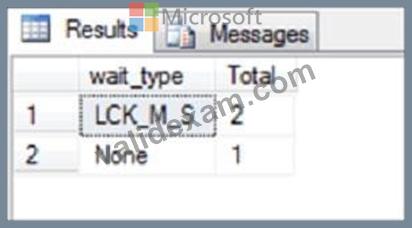
We see that we have two LCK_M_S wait types. This is the wait type we get when we have requests waiting on obtaining a shared lock. We can then query along with sys.dm_tran_locks to determine what types of locks these active requests were trying to obtain:
SELECT L.request_session_id, L.resource_type,L.resource_subtype, L.request_mode,
L.request_type
FROM sys.dm_tran_locks AS L
JOIN sys.dm_exec_requests AS DER
ON L.request_session_id = DER.session_id
WHERE DER.wait_type = 'LCK_M_S';
Incorrect:
Not A: Azure SQL database does not have sys.dm_pdw_nodes_tran_locks.
Not E: Azure SQL database does not have sys.dm_pdw_nodes_os_wait_stats.
Reference:
https://www.mssqltips.com/sqlservertip/5521/understanding-and-using-sql-server-sysdmexecrequests/
NEW QUESTION # 90
Your company analyzes images from security cameras and sends alerts to security teams that respond to unusual activity. The solution uses Azure Databricks.
You need to send Apache Spark level events, Spark Structured Streaming metrics, and application metrics to Azure Monitor.
Which three actions should you perform in sequence? To answer, move the appropriate actions from the list of actions in the answer area and arrange them in the correct order.
Answer:
Explanation:
Explanation:
Send application metrics using Dropwizard.
Spark uses a configurable metrics system based on the Dropwizard Metrics Library.
To send application metrics from Azure Databricks application code to Azure Monitor, follow these steps:
Step 1: Configure your Azure Databricks cluster to use the Databricksmonitoring library.
Prerequisite: Configure your Azure Databricks cluster to use the monitoring library.
Step 2: Build the spark-listeners-loganalytics-1.0-SNAPSHOT.jar JAR file Step 3: Create Dropwizard counters in your application code Create Dropwizard gauges or counters in your application code
NEW QUESTION # 91
......
Microsoft DP-300: Key Details and Main Topics
The DP-300 exam is the only required test to obtain the Microsoft Certified: Azure Database Administrator Associate certification. The candidates for the exam must pay the fee of $165 before scheduling their appointment. Depending on their preferred language, they can choose to take this test in English, Korean, Japanese, and Simplified Chinese. This exam contains about 40-60 questions delivered in different formats, including drag and drop, build list, case studies, active screen, and multiple choice. You can find the samples of these question types on the official website. The allocated time ranges from 120 to 150 minutes.
Authentic DP-300 Dumps With 100% Passing Rate Practice Tests Dumps: https://www.validexam.com/DP-300-latest-dumps.html
Updated Premium DP-300 Exam Engine pdf: https://drive.google.com/open?id=1LM3YBTxcviK_6tdYwUISluemuRtLz4iz