


Best Quality Google Professional-Machine-Learning-Engineer Exam Questions ValidExam Realistic Practice Exams [2024]
Critical Information To Google Professional Machine Learning Engineer Pass the First Time
NEW QUESTION # 90
You developed a Vertex Al ML pipeline that consists of preprocessing and training steps and each set of steps runs on a separate custom Docker image Your organization uses GitHub and GitHub Actions as CI/CD to run unit and integration tests You need to automate the model retraining workflow so that it can be initiated both manually and when a new version of the code is merged in the main branch You want to minimize the steps required to build the workflow while also allowing for maximum flexibility How should you configure the CI/CD workflow?
- A. Trigger GitHub Actions to run the tests build custom Docker images push the images to Artifact Registry, and launch the pipeline in Vertex Al Pipelines.
- B. Trigger GitHub Actions to run the tests launch a Cloud Build workflow to build custom Dicker images, push the images to Artifact Registry, and launch the pipeline in Vertex Al Pipelines.
- C. Trigger GitHub Actions to run the tests launch a job on Cloud Run to build custom Docker images push the images to Artifact Registry and launch the pipeline in Vertex Al Pipelines.
- D. Trigger a Cloud Build workflow to run tests build custom Docker images, push the images to Artifact Registry and launch the pipeline in Vertex Al Pipelines.
Answer: A
NEW QUESTION # 91
Your team is building an application for a global bank that will be used by millions of customers. You built a forecasting model that predicts customers1 account balances 3 days in the future. Your team will use the results in a new feature that will notify users when their account balance is likely to drop below $25. How should you serve your predictions?
- A. 1. Create a Pub/Sub topic for each user
2 Deploy a Cloud Function that sends a notification when your model predicts that a user's account balance will drop below the $25 threshold. - B. 1. Build a notification system on Firebase
2. Register each user with a user ID on the Firebase Cloud Messaging server, which sends a notification when the average of all account balance predictions drops below the $25 threshold - C. 1 Build a notification system on Firebase
2. Register each user with a user ID on the Firebase Cloud Messaging server, which sends a notification when your model predicts that a user's account balance will drop below the $25 threshold - D. 1. Create a Pub/Sub topic for each user
2. Deploy an application on the App Engine standard environment that sends a notification when your model predicts that a user's account balance will drop below the $25 threshold
Answer: D
NEW QUESTION # 92
You are building a MLOps platform to automate your company's ML experiments and model retraining. You need to organize the artifacts for dozens of pipelines How should you store the pipelines' artifacts'?
- A. Store parameters in Cloud SQL and store the models' source code and binaries in GitHub
- B. Store parameters in Cloud SQL store the models' source code in GitHub, and store the models' binaries in Cloud Storage.
- C. Store parameters in Vertex ML Metadata store the models' source code in GitHub and store the models' binaries in Cloud Storage.
- D. Store parameters in Vertex ML Metadata and store the models source code and binaries in GitHub.
Answer: C
NEW QUESTION # 93
You are building a TensorFlow text-to-image generative model by using a dataset that contains billions of images with their respective captions. You want to create a low maintenance, automated workflow that reads the data from a Cloud Storage bucket collects statistics, splits the dataset into training/validation/test datasets performs data transformations, trains the model using the training/validation datasets. and validates the model by using the test dataset. What should you do?
- A. Use the MLFlow SDK and deploy it on a Google Kubernetes Engine Cluster Create multiple components that use Dataflow and Vertex Al services.
- B. Use the Kubeflow Pipelines (KFP) SDK to create multiple components that use Dataflow and Vertex Al services Deploy the workflow on Vertex Al Pipelines.
- C. Use the TensorFlow Extended (TFX) SDK to create multiple components that use Dataflow and Vertex Al services Deploy the workflow on Vertex Al Pipelines.
- D. Use the Apache Airflow SDK to create multiple operators that use Dataflow and Vertex Al services Deploy the workflow on Cloud Composer.
Answer: C
NEW QUESTION # 94
You are building a real-time prediction engine that streams files which may contain Personally Identifiable Information (Pll) to Google Cloud. You want to use the Cloud Data Loss Prevention (DLP) API to scan the files. How should you ensure that the Pll is not accessible by unauthorized individuals?
- A. Periodically conduct a bulk scan of that bucket using the DLP API, and move the data to either the Sensitive or Non-Sensitive bucket
- B. Stream all files to Google Cloud, and write batches of the data to BigQuery While the data is being written to BigQuery conduct a bulk scan of the data using the DLP API.
- C. Create two buckets of data Sensitive and Non-sensitive Write all data to the Non-sensitive bucket Periodically conduct a bulk scan of that bucket using the DLP API, and move the sensitive data to the Sensitive bucket
- D. Create three buckets of data: Quarantine, Sensitive, and Non-sensitive Write all data to the Quarantine bucket.
- E. Stream all files to Google CloudT and then write the data to BigQuery Periodically conduct a bulk scan of the table using the DLP API.
Answer: D
Explanation:
The Cloud DLP API is a service that allows users to inspect, classify, and de-identify sensitive data. It can be used to scan data in Cloud Storage, BigQuery, Cloud Datastore, and Cloud Pub/Sub. The best way to ensure that the PII is not accessible by unauthorized individuals is to use a quarantine bucket to store the data before scanning it with the DLP API. This way, the data is isolated from other applications and users until it is classified and moved to the appropriate bucket. The other options are not as secure or efficient, as they either expose the data to BigQuery before scanning, or scan the data after writing it to a non-sensitive bucket.
References:
* Cloud DLP documentation
* Scanning and classifying Cloud Storage files
NEW QUESTION # 95
You have been tasked with deploying prototype code to production. The feature engineering code is in PySpark and runs on Dataproc Serverless. The model training is executed by using a Vertex Al custom training job. The two steps are not connected, and the model training mustcurrently be run manually after the feature engineering step finishes. You need to create a scalable and maintainable production process that runs end-to-end and tracks the connections between steps. What should you do?
- A. Create a Vertex Al Pipelines job to link and run both components Use the Kubeflow pipelines SDK to write code that specifies two components
- The first component initiates an Apache Spark context that runs the PySpark feature engineering code
- The second component runs the TensorFlow custom model training code Create a Vertex Al Pipelines job to link and run both components - B. Use the Kubeflow pipelines SDK to write code that specifies two components
- The first is a Dataproc Serverless component that launches the feature engineering job
- The second is a custom component wrapped in the
creare_cusrora_rraining_job_from_ccraponent Utility that launches the custom model training job. - C. Create a Vertex Al Workbench notebook Use the notebook to submit the Dataproc Serverless feature engineering job Use the same notebook to submit the custom model training job Run the notebook cells sequentially to tie the steps together end-to-end
- D. Create a Vertex Al Workbench notebook Initiate an Apache Spark context in the notebook, and run the PySpark feature engineering code Use the same notebook to run the custom model training job in TensorFlow Run the notebook cells sequentially to tie the steps together end-to-end
Answer: B
Explanation:
The best option for creating a scalable and maintainable production process that runs end-to-end and tracks the connections between steps, using prototype code to production, feature engineering code in PySpark that runs on Dataproc Serverless, and model training that is executed by using a Vertex AI custom training job, is to use the Kubeflow pipelines SDK to write code that specifies two components. The first is a Dataproc Serverless component that launches the feature engineering job. The second is a custom component wrapped in the create_custom_training_job_from_component utility that launches the custom model training job. This option allows you to leverage the power and simplicity of Kubeflow pipelines to orchestrate and automate your machine learning workflows on Vertex AI. Kubeflow pipelines is a platform that can build, deploy, and manage machine learning pipelines on Kubernetes. Kubeflow pipelines can help you create reusable and scalable pipelines, experiment with different pipeline versions and parameters, and monitor and debug your pipelines. Kubeflow pipelines SDK is a set of Python packages that can help you build and run Kubeflow pipelines. Kubeflow pipelines SDK can help you define pipeline components, specify pipeline parameters and inputs, and create pipeline steps and tasks. A component is a self-contained set of code that performs one step in a pipeline, such as data preprocessing, model training, or model evaluation. A component can be created from a Python function, a container image, or a prebuilt component. A custom component is a component that is not provided by Kubeflow pipelines, but is created by the user to perform a specific task. A custom component can be wrapped in a utility function that can help you create a Vertex AI custom training job from the component. A custom training job is a resource that can run your custom training code on Vertex AI. A custom training job can help you train various types of models, such as linear regression, logistic regression, k-means clustering, matrix factorization, and deep neural networks. By using the Kubeflow pipelines SDK to write code that specifies two components, the first is a Dataproc Serverless component that launches the feature engineering job, and the second is a custom component wrapped in the create_custom_training_job_from_component utility that launches the custom model training job, you can create a scalable and maintainable production process that runs end-to-end and tracks the connections between steps. You can write code that defines the two components, their inputs and outputs, and their dependencies.
You can then use the Kubeflow pipelines SDK to create a pipeline that runs the two components in sequence, and submit the pipeline to Vertex AI Pipelines for execution. By using Dataproc Serverless component, you can run your PySpark feature engineering code on Dataproc Serverless, which is a service that can run Spark batch workloads without provisioning and managing your own cluster. By using custom component wrapped in the create_custom_training_job_from_component utility, you can run your custom model training code on Vertex AI, which is a unified platform for building and deploying machine learning solutions on Google Cloud1.
The other options are not as good as option C, for the following reasons:
* Option A: Creating a Vertex AI Workbench notebook, using the notebook to submit the Dataproc Serverless feature engineering job, using the same notebook to submit the custom model training job, and running the notebook cells sequentially to tie the steps together end-to-end would require more skills and steps than using the Kubeflow pipelines SDK to write code that specifies two components, the first is a Dataproc Serverless component that launches the feature engineering job, and the second is a custom component wrapped in the create_custom_training_job_from_component utility that launches the custom model training job. Vertex AI Workbench is a service that can provide managed notebooks for machine learning development and experimentation. Vertex AI Workbench can help you create and run JupyterLab notebooks, and access various tools and frameworks, such as TensorFlow, PyTorch, and JAX. By creating a Vertex AI Workbench notebook, using the notebook to submit the Dataproc Serverless feature engineering job, using the same notebook to submit the custom model training job, and running the notebook cells sequentially to tie the steps together end-to-end, you can create a production process that runs end-to-end and tracks the connections between steps. You can write code that submits the Dataproc Serverless feature engineering job and the custom model training job to Vertex AI, and run the code in the notebook cells. However, creating a Vertex AI Workbench notebook,
* using the notebook to submit the Dataproc Serverless feature engineering job, using the same notebook to submit the custom model training job, and running the notebook cells sequentially to tie the steps together end-to-end would require more skills and steps than using the Kubeflow pipelinesSDK to write code that specifies two components, the first is a Dataproc Serverless component that launches the feature engineering job, and the second is a custom component wrapped in the create_custom_training_job_from_component utility that launches the custom model training job. You would need to write code, create and configure the Vertex AI Workbench notebook, submit the Dataproc Serverless feature engineering job and the custom model training job, and run the notebook cells. Moreover, this option would not use the Kubeflow pipelines SDK, which can simplify the pipeline creation and execution process, and provide various features, such as pipeline parameters, pipeline metrics, and pipeline visualization2.
* Option B: Creating a Vertex AI Workbench notebook, initiating an Apache Spark context in the notebook, and running the PySpark feature engineering code, using the same notebook to run the custom model training job in TensorFlow, and running the notebook cells sequentially to tie the steps together end-to-end would not allow you to use Dataproc Serverless to run the feature engineering job, and could increase the complexity and cost of the production process. Apache Spark is a framework that can perform large-scale data processing and machine learning. Apache Spark can help you run various tasks, such as data ingestion, data transformation, data analysis, and data visualization. PySpark is a Python API for Apache Spark. PySpark can help you write and run Spark code in Python. An Apache Spark context is a resource that can initialize and configure the Spark environment. An Apache Spark context can help you create and manage Spark objects, such as SparkSession, SparkConf, and SparkContext. By creating a Vertex AI Workbench notebook, initiating an Apache Spark context in the notebook, and running the PySpark feature engineering code, using the same notebook to run the custom model training job in TensorFlow, and running the notebook cells sequentially to tie the steps together end-to-end, you can create a production process that runs end-to-end and tracks the connections between steps. You can write code that initiates an Apache Spark context and runs the PySpark feature engineering code, and runs the custom model training job in TensorFlow, and run the code in the notebook cells. However, creating a Vertex AI Workbench notebook, initiating an Apache Spark context in the notebook, and running the PySpark feature engineering code, using the same notebook to run the custom model training job in TensorFlow, and running the notebook cells sequentially to tie the steps together end-to-end would not allow you to use Dataproc Serverless to run the feature engineering job, and could increase the complexity and cost of the production process. You would need to write code, create and configure the Vertex AI Workbench notebook, initiate and configure the Apache Spark context, run the PySpark feature engineering code, and run the custom model training job in TensorFlow. Moreover, this option would not use Dataproc Serverless, which is a service that can run Spark batch workloads without provisioning and managing your own cluster, and provide various benefits, such as autoscaling, dynamic resource allocation, and serverless billing2.
* Option D: Creating a Vertex AI Pipelines job to link and run both components, using the Kubeflow pipelines SDK to write code that specifies two components, the first component initiates an Apache Spark context that runs the PySpark feature engineering code, and the second component runs the TensorFlow custom model training code, would not allow you to use Dataproc Serverless to run the feature engineering job, and could increase the complexity and cost of the production process. Vertex AI Pipelines is a service that can run Kubeflow pipelines on Vertex AI. Vertex AI Pipelines can help you create and manage machine learning pipelines, and integrate with various Vertex AI services, such as Vertex AI Workbench, VertexAI Training, and Vertex AI Prediction. A Vertex AI Pipelines job is a resource that can execute a pipeline on Vertex AI Pipelines. A Vertex AI Pipelines job can help you run your pipeline steps and tasks, and monitor and debug your pipeline execution. By creating a Vertex AI Pipelines job to link and run both components, using the Kubeflow pipelines SDK to write code that specifies two components, the first component initiates an Apache Spark context that runs the PySpark
* feature engineering code, and the second component runs the TensorFlow custom model training code, you can create a scalable and maintainable production process that runs end-to-end and tracks the connections between steps. You can write code that defines the two components, their inputs and outputs, and their dependencies. You can then use the Kubeflow pipelines SDK to create a pipeline that runs the two components in sequence, and submit the pipeline to Vertex AI Pipelines for execution.
However, creating a Vertex AI Pipelines job to link and run both components, using the Kubeflow pipelines SDK to write code that specifies two components, the first component initiates an Apache Spark context that runs the PySpark feature engineering code,
NEW QUESTION # 96
You are an ML engineer at a regulated insurance company. You are asked to develop an insurance approval model that accepts or rejects insurance applications from potential customers. What factors should you consider before building the model?
- A. Federated learning, reproducibility, and explainability
- B. Traceability, reproducibility, and explainability
- C. Redaction, reproducibility, and explainability
- D. Differential privacy federated learning, and explainability
Answer: C
NEW QUESTION # 97
You work for a large retailer and you need to build a model to predict customer churn. The company has a dataset of historical customer data, including customer demographics, purchase history, and website activity.
You need to create the model in BigQuery ML and thoroughly evaluate its performance. What should you do?
- A. Create a linear regression model in BigQuery ML Use the ml. evaluate function to evaluate the model performance.
- B. Create a logistic regression model in BigQuery ML Use the ml.confusion_matrix function to evaluate the model performance.
- C. Create a linear regression model in BigQuery ML and register the model in Vertex Al Model Registry Evaluate the model performance in Vertex Al.
- D. Create a logistic regression model in BigQuery ML and register the model in Vertex Al Model Registry.
Evaluate the model performance in Vertex Al.
Answer: D
Explanation:
Customer churn is a binary classification problem, where the target variable is whether a customer has churned or not. Therefore, a logistic regression model is more suitable than a linear regression model, which is used for regression problems. A logistic regression model can output the probability of a customer churning, which can be used to rank the customers by their churn risk and take appropriate actions1.
BigQuery ML is a service that allows you to create and execute machine learning models in BigQuery using standard SQL queries2. You can use BigQuery ML to create a logistic regression model for customer churn prediction by using the CREATE MODEL statement and specifying the LOGISTIC_REG model type3. You can use the historical customer data as the input table for the model, and specify the features and the label columns3.
Vertex AI Model Registry is a central repository where you can manage the lifecycle of your ML models4. You can import models from various sources, such as BigQuery ML, AutoML, or custom models, and assign them to different versions and aliases4. You can also deploy models to endpoints, which are resources that provide a service URL for online prediction.
By registering the BigQuery ML model in Vertex AI Model Registry, you can leverage the Vertex AI features to evaluate and monitor the model performance4. You can use Vertex AI Experiments to track and compare the metrics of different model versions, such as accuracy, precision, recall, and AUC. You can also use Vertex AI Explainable AI to generate feature attributions that show how much each input feature contributed to the model's prediction.
The other options are not suitable for your scenario, because they either use the wrong model type, such as linear regression, or they do not use Vertex AI to evaluate the model performance, which would limit the insights and actions you can take based on the model results.
References:
* Logistic Regression for Machine Learning
* Introduction to BigQuery ML | Google Cloud
* Creating a logistic regression model | BigQuery ML | Google Cloud
* Introduction to Vertex AI Model Registry | Google Cloud
* [Deploy a model to an endpoint | Vertex AI | Google Cloud]
* [Vertex AI Experiments | Google Cloud]
NEW QUESTION # 98
You work for a bank with strict data governance requirements. You recently implemented a custom model to detect fraudulent transactions You want your training code to download internal data by using an API endpoint hosted in your projects network You need the data to be accessed in the most secure way, while mitigating the risk of data exfiltration. What should you do?
- A. Configure VPC Peering with Vertex Al and specify the network of the training job
- B. Enable VPC Service Controls for peering's, and add Vertex Al to a service perimeter
- C. Create a Cloud Run endpoint as a proxy to the data Use Identity and Access Management (1AM) authentication to secure access to the endpoint from the training job.
- D. Download the data to a Cloud Storage bucket before calling the training job
Answer: B
Explanation:
The best option for accessing internal data in the most secure way, while mitigating the risk of data exfiltration, is to enable VPC Service Controls for peerings, and add Vertex AI to a service perimeter. This option allows you to leverage the power and simplicity of VPC Service Controls to isolate and protect your data and services on Google Cloud. VPC Service Controls is a service that can create a secure perimeter around your Google Cloud resources, such as BigQuery, Cloud Storage, and Vertex AI. VPC Service Controls can help you prevent unauthorized access and data exfiltration from your perimeter, and enforce fine-grained access policies based on context and identity. Peerings are connections that can allow traffic to flow between different networks. Peerings can help you connect your Google Cloud network with other Google Cloud networks or external networks, and enable communication between your resources and services. By enabling VPC Service Controls for peerings, you can allow your training code to download internal data by using an API endpoint hosted in your project's network, and restrict the data transfer to only authorized networks and services. Vertex AI is a unified platform for building and deploying machine learning solutions on Google Cloud. Vertex AI can support various types of models, such as linear regression, logistic regression, k-means clustering, matrix factorization, and deep neural networks. Vertex AI can also provide various tools and services for data analysis, model development, model deployment, model monitoring, and model governance. By adding Vertex AI to a service perimeter, you can isolate and protect your Vertex AI resources, such as models, endpoints, pipelines, and feature store, and prevent data exfiltration from your perimeter1.
The other options are not as good as option A, for the following reasons:
* Option B: Creating a Cloud Run endpoint as a proxy to the data, and using Identity and Access Management (IAM) authentication to secure access to the endpoint from the training job would require more skills and steps than enabling VPC Service Controls for peerings, and adding Vertex AI to a service perimeter. Cloud Run is a service that can run your stateless containers on a fully managed environment or on your own Google Kubernetes Engine cluster. Cloud Run can help you deploy and scale your containerized applications quickly and easily, and pay only for the resources you use. A Cloud Run endpoint is a URL that can expose your containerized application to the internet or to other Google Cloud services. A Cloud Run endpoint can help you access and invoke your application from anywhere, and handle the load balancing and traffic routing. A proxy is a server that can act as an intermediary between a client and a target server. A proxy can help you modify, filter, or redirect the requests and responses between the client and the target server, and provide additional functionality or security. IAM is a service that can manage access control for Google Cloud resources. IAM can help you define who (identity) has what access (role) to which resource, and enforce the access policies. By creating a Cloud Run endpoint as a proxy to the data, and using IAM authentication to secure access to the endpoint from the training job, you can access internal data by using an API endpoint hosted in your project's network, and restrict the data access to only authorized identities and roles. However, creating a Cloud Run endpoint as a proxy to the data, and using IAM authentication to secure access to the endpoint from the training job would require more skills and steps than enabling VPC Service Controls for peerings, and adding Vertex AI to a service perimeter. You would need to write code, create and configure the Cloud Run endpoint, implement the proxy logic, deploy and monitor the Cloud Run endpoint, and set up the IAM policies. Moreover, this option would not prevent data exfiltration from your network, as the Cloud Run endpoint can be accessed from outside your network2.
* Option C: Configuring VPC Peering with Vertex AI and specifying the network of the training job would not allow you to access internal data by using an API endpoint hosted in your project's network, and could cause errors or poor performance. VPC Peering is a service that can create a peering connection between two VPC networks. VPC Peering can help you connect your Google Cloud network with another Google Cloud network or an external network, and enable communication between your resources and services. By configuring VPC Peering with Vertex AI and specifying the network of the training job, you can allow your training code to access Vertex AI resources, such as models, endpoints, pipelines, and feature store, and use the same network for the training job. However, configuring VPC Peering with Vertex AI and specifying the network of the training job would not allow you to access internal data by using an API endpoint hosted in your project's network, and could cause errors or poor performance. You would need to write code, create and configure the VPC Peering connection, and specify the network of the training job. Moreover, this option would not isolate and protect your data and services on Google Cloud, as the VPC Peering connection can expose your network to other networks and services3.
* Option D: Downloading the data to a Cloud Storage bucket before calling the training job would not allow you to access internal data by using an API endpoint hosted in your project's network, and could increase the complexity and cost of the data access. Cloud Storage is a service that can store and manage your data on Google Cloud. Cloud Storage can help you upload and organize your data, and track the data versions and metadata. A Cloud Storage bucket is a container that can hold your data on Cloud Storage. A Cloud Storage bucket canhelp you store and access your data from anywhere, and provide various storage classes and options. By downloading the data to a Cloud Storage bucket before calling the training job, you can access the data from Cloud Storage, and use it as the input for the training job.
However, downloading the data to a Cloud Storage bucket before calling the training job would not allow you to access internal data by using an API endpoint hosted in your project's network, and could increase the complexity and cost of the data access. You would need to write code, create and configure
* the Cloud Storage bucket, download the data to the Cloud Storage bucket, and call the training job. Moreover, this option would create an intermediate data source on Cloud Storage, which can increase the storage and transfer costs, and expose the data to unauthorized access or data exfiltration4.
References:
* Preparing for Google Cloud Certification: Machine Learning Engineer, Course 3: Production ML Systems, Week 1: Data Engineering
* Google Cloud Professional Machine Learning Engineer Exam Guide, Section 1: Framing ML problems,
1.2 Defining data needs
* Official Google Cloud Certified Professional Machine Learning Engineer Study Guide, Chapter 2: Data Engineering, Section 2.2: Defining Data Needs
* VPC Service Controls
* Cloud Run
* VPC Peering
* Cloud Storage
NEW QUESTION # 99
You are training an LSTM-based model on Al Platform to summarize text using the following job submission script: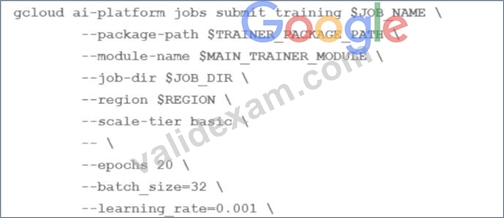
You want to ensure that training time is minimized without significantly compromising the accuracy of your model. What should you do?
- A. Modify the 'learning rate' parameter
- B. Modify the 'epochs' parameter
- C. Modify the batch size' parameter
- D. Modify the 'scale-tier' parameter
Answer: D
Explanation:
The training time of a machine learning model depends on several factors, such as the complexity of the model, the size of the data, the hardware resources, and the hyperparameters. To minimize the training time without significantly compromising the accuracy of the model, one should optimize these factors as much as possible.
One of the factors that can have a significant impact on the training time is the scale-tier parameter, which specifies the type and number of machines to use for the training job on AI Platform. The scale-tier parameter can be one of the predefined values, such as BASIC, STANDARD_1, PREMIUM_1, or BASIC_GPU, or a custom value that allows you to configure the machine type, the number of workers, and the number of parameter servers1 To speed up the training of an LSTM-based model on AI Platform, one should modify the scale-tier parameter to use a higher tier or a custom configuration that provides more computational resources, such as more CPUs, GPUs, or TPUs. This can reduce the training time by increasing the parallelism and throughput of the model training. However, one should also consider the trade-off between the training time and the cost, as higher tiers or custom configurations may incur higher charges2 The other options are not as effective or may have adverse effects on the model accuracy. Modifying the epochs parameter, which specifies the number of times the model sees the entire dataset, may reduce the training time, but also affect the model's convergence and performance. Modifying the batch size parameter, which specifies the number of examples per batch, may affect the model's stability and generalization ability, as well as the memory usage and the gradient update frequency. Modifying the learning rate parameter, which specifies the step size of the gradient descent optimization, may affect the model's convergence and performance, as well as the risk of overshooting or getting stuck in local minima3 References: 1: Using predefined machine types 2: Distributed training 3: Hyperparameter tuning overview
NEW QUESTION # 100
You work on a growing team of more than 50 data scientists who all use AI Platform. You are designing a strategy to organize your jobs, models, and versions in a clean and scalable way. Which strategy should you choose?
- A. Use labels to organize resources into descriptive categories. Apply a label to each created resource so that users can filter the results by label when viewing or monitoring the resources.
- B. Set up restrictive IAM permissions on the AI Platform notebooks so that only a single user or group can access a given instance.
- C. Set up a BigQuery sink for Cloud Logging logs that is appropriately filtered to capture information about AI Platform resource usage. In BigQuery, create a SQL view that maps users to the resources they are using
- D. Separate each data scientist's work into a different project to ensure that the jobs, models, and versions created by each data scientist are accessible only to that user.
Answer: B
NEW QUESTION # 101
You work for an auto insurance company. You are preparing a proof-of-concept ML application that uses images of damaged vehicles to infer damaged parts Your team has assembled a set of annotated images from damage claim documents in the company's database The annotations associated with each image consist of a bounding box for each identified damaged part and the part name. You have been given a sufficient budget to tram models on Google Cloud You need to quickly create an initial model What should you do?
- A. Create a pipeline in Vertex Al Pipelines and configure the AutoMLTrainingJobRunOp compon it to train a custom object detection model by using the annotated image data.
- B. Train an object detection model in AutoML by using the annotated image data.
- C. Train an object detection model in Vertex Al custom training by using the annotated image data.
- D. Download a pre-trained object detection mode! from TensorFlow Hub Fine-tune the model in Vertex Al Workbench by using the annotated image data.
Answer: B
Explanation:
According to the official exam guide1, one of the skills assessed in the exam is to "design, build, and productionalize ML models to solve business challenges using Google Cloud technologies". AutoML Vision2 is a service that allows you to train and deploy custom vision models for image classification and object detection. AutoML Vision simplifies the model development process by providing a graphical user interface and a no-code approach. You can use AutoML Vision to train an object detection model by using the annotated image data, and evaluate the model performance using metrics such as mean average precision (mAP) and intersection over union (IoU)3. Therefore, option B is the best way to quickly create an initial model for the given use case. The other options are not relevant or optimal for this scenario. References:
* Professional ML Engineer Exam Guide
* AutoML Vision
* Object detection evaluation
* Google Professional Machine Learning Certification Exam 2023
* Latest Google Professional Machine Learning Engineer Actual Free Exam Questions
NEW QUESTION # 102
You are training an object detection machine learning model on a dataset that consists of three million X-ray images, each roughly 2 GB in size. You are using Vertex AI Training to run a custom training application on a Compute Engine instance with 32-cores, 128 GB of RAM, and 1 NVIDIA P100 GPU. You notice that model training is taking a very long time. You want to decrease training time without sacrificing model performance. What should you do?
- A. Use the tf.distribute.Strategy API and run a distributed training job.
- B. Replace the NVIDIA P100 GPU with a v3-32 TPU in the training job.
- C. Increase the instance memory to 512 GB and increase the batch size.
- D. Enable early stopping in your Vertex AI Training job.
Answer: D
NEW QUESTION # 103
You work for a large hotel chain and have been asked to assist the marketing team in gathering predictions for a targeted marketing strategy. You need to make predictions about user lifetime value (LTV) over the next 30 days so that marketing can be adjusted accordingly. The customer dataset is in BigQuery, and you are preparing the tabular data for training with AutoML Tables. This data has a time signal that is spread across multiple columns. How should you ensure that AutoML fits the best model to your data?
- A. Submit the data for training without performing any manual transformations Use the columns that have a time signal to manually split your data Ensure that the data in your validation set is from 30 days after the data in your training set and that the data in your testing set is from 30 days after your validation set
- B. Submit the data for training without performing any manual transformations Allow AutoML to handle the appropriate transformations Choose an automatic data split across the training, validation, and testing sets
- C. Submit the data for training without performing any manual transformations, and indicate an appropriate column as the Time column Allow AutoML to split your data based on the time signal provided, and reserve the more recent data for the validation and testing sets
- D. Manually combine all columns that contain a time signal into an array Allow AutoML to interpret this array appropriately Choose an automatic data split across the training, validation, and testing sets
Answer: A
NEW QUESTION # 104
You have deployed multiple versions of an image classification model on Al Platform. You want to monitor the performance of the model versions overtime. How should you perform this comparison?
- A. Compare the mean average precision across the models using the Continuous Evaluation feature
- B. Compare the loss performance for each model on a held-out dataset.
- C. Compare the receiver operating characteristic (ROC) curve for each model using the What-lf Tool
- D. Compare the loss performance for each model on the validation data
Answer: A
Explanation:
https://cloud.google.com/ai-platform/prediction/docs/continuous-evaluation/view-metrics
NEW QUESTION # 105
You work for an online grocery store. You recently developed a custom ML model that recommends a recipe when a user arrives at the website. You chose the machine type on the Vertex Al endpoint to optimize costs by using the queries per second (QPS) that the model can serve, and you deployed it on a single machine with 8 vCPUs and no accelerators.
A holiday season is approaching and you anticipate four times more traffic during this time than the typical daily traffic You need to ensure that the model can scale efficiently to the increased demand. What should you do?
- A. 1 Maintain the same machine type on the endpoint Configure the endpoint to enable autoscalling based on vCPU usage.
2 Set up a monitoring job and an alert for CPU usage
3 If you receive an alert investigate the cause - B. 1, Maintain the same machine type on the endpoint.
2 Set up a monitoring job and an alert for CPU usage
3 If you receive an alert add a compute node to the endpoint - C. 1 Change the machine type on the endpoint to have a GPU_ Configure the endpoint to enable autoscaling based on the GPU usage.
2 Set up a monitoring job and an alert for GPU usage.
3 If you receive an alert investigate the cause. - D. 1 Change the machine type on the endpoint to have 32 vCPUs
2. Set up a monitoring job and an alert for CPU usage
3 If you receive an alert, scale the vCPUs further as needed
Answer: A
NEW QUESTION # 106
......
Professional-Machine-Learning-Engineer EXAM DUMPS WITH GUARANTEED SUCCESS: https://www.validexam.com/Professional-Machine-Learning-Engineer-latest-dumps.html
Best Quality Google Professional-Machine-Learning-Engineer Exam Questions: https://drive.google.com/open?id=1yHYubFBWqqDEkMl36xN7gbKz1YT-r7l2