


Updated CT-AI Dumps PDF - CT-AI Real Valid Brain Dumps With 40 Questions!
100% Free CT-AI Exam Dumps Use Real ISTQB AI Testing Dumps
NEW QUESTION # 19
Which ONE of the following options is an example that BEST describes a system with Al-based autonomous functions?
SELECT ONE OPTION
- A. A fully automated manufacturing plant that uses no software.
- B. A system that utilizes a tool like Selenium.
- C. A system that utilizes human beings for all important decisions.
- D. A system that is fully able to respond to its environment.
Answer: D
Explanation:
* AI-Based Autonomous Functions: An AI-based autonomous system is one that can respond to its environment without human intervention. The other options either involve human decisions or do not use AI at all.
* Reference: ISTQB_CT-AI_Syllabus_v1.0, Sections on Autonomy and Testing Autonomous AI-Based Systems.
NEW QUESTION # 20
A software component uses machine learning to recognize the digits from a scan of handwritten numbers. In the scenario above, which type of Machine Learning (ML) is this an example of?
SELECT ONE OPTION
- A. Regression
- B. Classification
- C. Clustering
- D. Reinforcement learning
Answer: B
Explanation:
Recognizing digits from a scan of handwritten numbers using machine learning is an example of classification. Here's a breakdown:
Classification: This type of machine learning involves categorizing input data into predefined classes. In this scenario, the input data (handwritten digits) are classified into one of the 10 digit classes (0-9).
Why Not Other Options:
Reinforcement Learning: This involves learning by interacting with an environment to achieve a goal, which does not fit the problem of recognizing digits.
Regression: This is used for predicting continuous values, not discrete categories like digit recognition.
Clustering: This involves grouping similar data points together without predefined classes, which is not the case here.
NEW QUESTION # 21
A ML engineer is trying to determine the correctness of the new open-source implementation *X", of a supervised regression algorithm implementation. R-Square is one of the functional performance metrics used to determine the quality of the model.
Which ONE of the following would be an APPROPRIATE strategy to achieve this goal?
SELECT ONE OPTION
- A. Drop 10% of the rows randomly and create another model and compare the R-Square scores of both the models.
- B. Compare the R-Square score of the model obtained using two different implementations that utilize two different programming languages while using the same algorithm and the same training and testing data.
- C. Train various models by changing the order of input features and verify that the R-Square score of these models vary significantly.
- D. Add 10% of the rows randomly and create another model and compare the R-Square scores of both the model.
Answer: B
Explanation:
A . Add 10% of the rows randomly and create another model and compare the R-Square scores of both the models.
Adding more data to the training set can affect the R-Square score, but it does not directly verify the correctness of the implementation.
B . Train various models by changing the order of input features and verify that the R-Square score of these models vary significantly.
Changing the order of input features should not significantly affect the R-Square score if the implementation is correct, but this approach is more about testing model robustness rather than correctness of the implementation.
C . Compare the R-Square score of the model obtained using two different implementations that utilize two different programming languages while using the same algorithm and the same training and testing data.
This approach directly compares the performance of two implementations of the same algorithm. If both implementations produce similar R-Square scores on the same training and testing data, it suggests that the new implementation "X" is correct.
D . Drop 10% of the rows randomly and create another model and compare the R-Square scores of both the models.
Dropping data can lead to variations in the R-Square score but does not directly verify the correctness of the implementation.
Therefore, option C is the most appropriate strategy because it directly compares the performance of the new implementation "X" with another implementation using the same algorithm and datasets, which helps in verifying the correctness of the implementation.
NEW QUESTION # 22
Which ONE of the following statements correctly describes the importance of flexibility for Al systems?
SELECT ONE OPTION
- A. Al systems require changing of operational environments; therefore, flexibility is required.
- B. Self-learning systems are expected to deal with new situations without explicitly having to program for it.
- C. Flexible Al systems allow for easier modification of the system as a whole.
- D. Al systems are inherently flexible.
Answer: C
Explanation:
Flexibility in AI systems is crucial for various reasons, particularly because it allows for easier modification and adaptation of the system as a whole.
AI systems are inherently flexible (A): This statement is not correct. While some AI systems may be designed to be flexible, they are not inherently flexible by nature. Flexibility depends on the system's design and implementation.
AI systems require changing operational environments; therefore, flexibility is required (B): While it's true that AI systems may need to operate in changing environments, this statement does not directly address the importance of flexibility for the modification of the system.
Flexible AI systems allow for easier modification of the system as a whole (C): This statement correctly describes the importance of flexibility. Being able to modify AI systems easily is critical for their maintenance, adaptation to new requirements, and improvement.
Self-learning systems are expected to deal with new situations without explicitly having to program for it (D): This statement relates to the adaptability of self-learning systems rather than their overall flexibility for modification.
Hence, the correct answer is C. Flexible AI systems allow for easier modification of the system as a whole.
Reference:
ISTQB CT-AI Syllabus Section 2.1 on Flexibility and Adaptability discusses the importance of flexibility in AI systems and how it enables easier modification and adaptability to new situations.
Sample Exam Questions document, Question #30 highlights the importance of flexibility in AI systems.
NEW QUESTION # 23
Which ONE of the following activities is MOST relevant when addressing the scenario where you have more than the required amount of data available for the training?
SELECT ONE OPTION
- A. Feature selection
- B. Data augmentation
- C. Data labeling
- D. Data sampling
Answer: D
Explanation:
A . Feature selection
Feature selection is the process of selecting the most relevant features from the data. While important, it is not directly about handling excess data.
B . Data sampling
Data sampling involves selecting a representative subset of the data for training. When there is more data than needed, sampling can be used to create a manageable dataset that maintains the statistical properties of the full dataset.
C . Data labeling
Data labeling involves annotating data for supervised learning. It is necessary for training models but does not address the issue of having excess data.
D . Data augmentation
Data augmentation is used to increase the size of the training dataset by creating modified versions of existing data. It is useful when there is insufficient data, not when there is excess data.
Therefore, the correct answer is B because data sampling is the most relevant activity when dealing with an excess amount of data for training.
NEW QUESTION # 24
Which ONE of the following options describes the LEAST LIKELY usage of Al for detection of GUI changes due to changes in test objects?
SELECT ONE OPTION
- A. Using a vision-based detection of the GUI layout changes before and after test object changes.
- B. Using a pixel comparison of the GUI before and after the change to check the differences.
- C. Using a computer vision to compare the GUI before and after the test object changes.
- D. Using a ML-based classifier to flag if changes in GUI are to be flagged for humans.
Answer: B
Explanation:
* A. Using a pixel comparison of the GUI before and after the change to check the differences.
Pixel comparison is a traditional method and does not involve AI . It compares images at the pixel level, which can be effective but is not an intelligent approach. It is not considered an AI usage and is the least likely usage of AI for detecting GUI changes.
* B. Using computer vision to compare the GUI before and after the test object changes.
Computer vision involves using AI techniques to interpret and process images. It is a likely usage of AI for detecting changes in the GUI .
* C. Using vision-based detection of the GUI layout changes before and after test object changes.
Vision-based detection is another AI technique where the layout and structure of the GUI are analyzed to detect changes. This is a typical application of AI .
* D. Using a ML-based classifier to flag if changes in GUI are to be flagged for humans.
An ML-based classifier can intelligently determine significant changes and decide if they need human review, which is a sophisticated AI application.
NEW QUESTION # 25
Which ONE of the following describes a situation of back-to-back testing the LEAST?
SELECT ONE OPTION
- A. Comparison of the results of a home-grown neural network model ML model with results in a neural network model implemented in a standard implementation (for example Pytorch) for same data
- B. Comparison of the results of the current neural network ML model on the current data set with a slightly modified data set.
- C. Comparison of the results of a neural network ML model with a current decision tree ML model for the same data.
- D. Comparison of the results of a current neural network model ML model implemented in platform A (for example Pytorch) with a similar neural network model ML model implemented in platform B (for example Tensorflow), for the same data.
Answer: C
Explanation:
Back-to-back testing is a method where the same set of tests are run on multiple implementations of the system to compare their outputs. This type of testing is typically used to ensure consistency and correctness by comparing the outputs of different implementations under identical conditions. Let's analyze the options given:
A . Comparison of the results of a current neural network model ML model implemented in platform A (for example Pytorch) with a similar neural network model ML model implemented in platform B (for example Tensorflow), for the same data.
This option describes a scenario where two different implementations of the same type of model are being compared using the same dataset. This is a typical back-to-back testing situation.
B . Comparison of the results of a home-grown neural network model ML model with results in a neural network model implemented in a standard implementation (for example Pytorch) for the same data.
This option involves comparing a custom implementation with a standard implementation, which is also a typical back-to-back testing scenario to validate the custom model against a known benchmark.
C . Comparison of the results of a neural network ML model with a current decision tree ML model for the same data.
This option involves comparing two different types of models (a neural network and a decision tree). This is not a typical scenario for back-to-back testing because the models are inherently different and would not be expected to produce identical results even on the same data.
D . Comparison of the results of the current neural network ML model on the current data set with a slightly modified data set.
This option involves comparing the outputs of the same model on slightly different datasets. This could be seen as a form of robustness testing or sensitivity analysis, but not typical back-to-back testing as it doesn't involve comparing multiple implementations.
Based on this analysis, option C is the one that describes a situation of back-to-back testing the least because it compares two fundamentally different models, which is not the intent of back-to-back testing.
NEW QUESTION # 26
Arihant Meditation is a startup using Al to aid people in deeper and better meditation based on analysis of various factors such as time and duration of the meditation, pulse and blood pressure, EEG patters etc. among others. Their model accuracy and other functional performance parameters have not yet reached their desired level.
Which ONE of the following factors is NOT a factor affecting the ML functional performance?
SELECT ONE OPTION
- A. The quality of the labeling
- B. Biased data
- C. The data pipeline
- D. The number of classes
Answer: D
Explanation:
* Factors Affecting ML Functional Performance: The data pipeline, quality of the labeling, and biased data are all factors that significantly affect the performance of machine learning models. The number of classes, while relevant for the model structure, is not a direct factor affecting the performance metrics such as accuracy or bias.
* Reference: ISTQB_CT-AI_Syllabus_v1.0, Sections on Data Quality and its Effect on the ML Model and ML Functional Performance Metrics.
NEW QUESTION # 27
Which ONE of the following characteristics is the least likely to cause safety related issues for an Al system?
SELECT ONE OPTION
- A. Robustness
- B. Self-learning
- C. Non-determinism
- D. High complexity
Answer: A
Explanation:
The question asks which characteristic is least likely to cause safety-related issues for an AI system. Let's evaluate each option:
Non-determinism (A): Non-deterministic systems can produce different outcomes even with the same inputs, which can lead to unpredictable behavior and potential safety issues.
Robustness (B): Robustness refers to the ability of the system to handle errors, anomalies, and unexpected inputs gracefully. A robust system is less likely to cause safety issues because it can maintain functionality under varied conditions.
High complexity (C): High complexity in AI systems can lead to difficulties in understanding, predicting, and managing the system's behavior, which can cause safety-related issues.
Self-learning (D): Self-learning systems adapt based on new data, which can lead to unexpected changes in behavior. If not properly monitored and controlled, this can result in safety issues.
Reference:
ISTQB CT-AI Syllabus Section 2.8 on Safety and AI discusses various factors affecting the safety of AI systems, emphasizing the importance of robustness in maintaining safe operation.
NEW QUESTION # 28
Which ONE of the following approaches to labelling requires the least time and effort?
SELECT ONE OPTION
- A. Internal
- B. Al-Assisted
- C. Pre-labeled dataset
- D. Outsourced
Answer: C
Explanation:
* Labelling Approaches: Among the options provided, pre-labeled datasets require the least time and effort because the data has already been labeled, eliminating the need for further manual or automated labeling efforts.
* Reference: ISTQB_CT-AI_Syllabus_v1.0, Section 4.5 Data Labelling for Supervised Learning, which discusses various approaches to data labeling, including pre-labeled datasets, and their associated time and effort requirements.
NEW QUESTION # 29
Which ONE of the following options does NOT describe an Al technology related characteristic which differentiates Al test environments from other test environments?
SELECT ONE OPTION
- A. The challenge of mimicking undefined scenarios generated due to self-learning
- B. Challenges resulting from low accuracy of the models.
- C. Challenges in the creation of scenarios of human handover for autonomous systems.
- D. The challenge of providing explainability to the decisions made by the system.
Answer: C
Explanation:
AI test environments have several unique characteristics that differentiate them from traditional test environments. Let's evaluate each option:
A . Challenges resulting from low accuracy of the models.
Low accuracy is a common challenge in AI systems, especially during initial development and training phases. Ensuring the model performs accurately in varied and unpredictable scenarios is a critical aspect of AI testing.
B . The challenge of mimicking undefined scenarios generated due to self-learning.
AI systems, particularly those that involve machine learning, can generate undefined or unexpected scenarios due to their self-learning capabilities. Mimicking and testing these scenarios is a unique challenge in AI environments.
C . The challenge of providing explainability to the decisions made by the system.
Explainability, or the ability to understand and articulate how an AI system arrives at its decisions, is a significant and unique challenge in AI testing. This is crucial for trust and transparency in AI systems.
D . Challenges in the creation of scenarios of human handover for autonomous systems.
While important, the creation of scenarios for human handover in autonomous systems is not a characteristic unique to AI test environments. It is more related to the operational and deployment challenges of autonomous systems rather than the intrinsic technology-related characteristics of AI .
Given the above points, option D is the correct answer because it describes a challenge related to operational deployment rather than a technology-related characteristic unique to AI test environments.
NEW QUESTION # 30
Which ONE of the following tests is MOST likely to describe a useful test to help detect different kinds of biases in ML pipeline?
SELECT ONE OPTION
- A. Testing the distribution shift in the training data for inappropriate bias.
- B. Check the input test data for potential sample bias.
- C. Testing the data pipeline for any sources for algorithmic bias.
- D. Test the model during model evaluation for data bias.
Answer: D
Explanation:
Detecting biases in the ML pipeline involves various tests to ensure fairness and accuracy throughout the ML process.
Testing the distribution shift in the training data for inappropriate bias (A): This involves checking if there is any shift in the data distribution that could lead to bias in the model. It is an important test but not the most direct method for detecting biases.
Test the model during model evaluation for data bias (B): This is a critical stage where the model is evaluated to detect any biases in the data it was trained on. It directly addresses potential data biases in the model.
Testing the data pipeline for any sources for algorithmic bias (C): This test is crucial as it helps identify biases that may originate from the data processing and transformation stages within the pipeline. Detecting sources of algorithmic bias ensures that the model does not inherit biases from these processes.
Check the input test data for potential sample bias (D): While this is an important step, it focuses more on the input data and less on the overall data pipeline.
Hence, the most likely useful test to help detect different kinds of biases in the ML pipeline is B. Test the model during model evaluation for data bias.
Reference:
ISTQB CT-AI Syllabus Section 8.3 on Testing for Algorithmic, Sample, and Inappropriate Bias discusses various tests that can be performed to detect biases at different stages of the ML pipeline.
Sample Exam Questions document, Question #32 highlights the importance of evaluating the model for biases.
NEW QUESTION # 31
Which ONE of the following tests is LEAST likely to be performed during the ML model testing phase?
SELECT ONE OPTION
- A. Testing the speed of the training of the model.
- B. Testing the speed of the prediction by the model.
- C. Testing the API of the service powered by the ML model.
- D. Testing the accuracy of the classification model.
Answer: A
Explanation:
The question asks which test is least likely to be performed during the ML model testing phase. Let's consider each option:
Testing the accuracy of the classification model (A): Accuracy testing is a fundamental part of the ML model testing phase. It ensures that the model correctly classifies the data as intended and meets the required performance metrics.
Testing the API of the service powered by the ML model (B): Testing the API is crucial, especially if the ML model is deployed as part of a service. This ensures that the service integrates well with other systems and that the API performs as expected.
Testing the speed of the training of the model (C): This is least likely to be part of the ML model testing phase. The speed of training is more relevant during the development phase when optimizing and tuning the model. During testing, the focus is more on the model's performance and behavior rather than how quickly it was trained.
Testing the speed of the prediction by the model (D): Testing the speed of prediction is important to ensure that the model meets performance requirements in a production environment, especially for real-time applications.
Reference:
ISTQB CT-AI Syllabus Section 3.2 on ML Workflow and Section 5 on ML Functional Performance Metrics discuss the focus of testing during the model testing phase, which includes accuracy and prediction speed but not the training speed.
NEW QUESTION # 32
Data used for an object detection ML system was found to have been labelled incorrectly in many cases.
Which ONE of the following options is most likely the reason for this problem?
SELECT ONE OPTION
- A. Accuracy issues
- B. Security issues
- C. Bias issues
- D. Privacy issues
Answer: A
Explanation:
The question refers to a problem where data used for an object detection ML system was labelled incorrectly. This issue is most closely related to "accuracy issues." Here's a detailed explanation:
Accuracy Issues: The primary goal of labeling data in machine learning is to ensure that the model can accurately learn and make predictions based on the given labels. Incorrectly labeled data directly impacts the model's accuracy, leading to poor performance because the model learns incorrect patterns.
Why Not Other Options:
Security Issues: This pertains to data breaches or unauthorized access, which is not relevant to the problem of incorrect data labeling.
Privacy Issues: This concerns the protection of personal data and is not related to the accuracy of data labeling.
Bias Issues: While bias in data can affect model performance, it specifically refers to systematic errors or prejudices in the data rather than outright incorrect labeling.
NEW QUESTION # 33
Upon testing a model used to detect rotten tomatoes, the following data was observed by the test engineer, based on certain number of tomato images.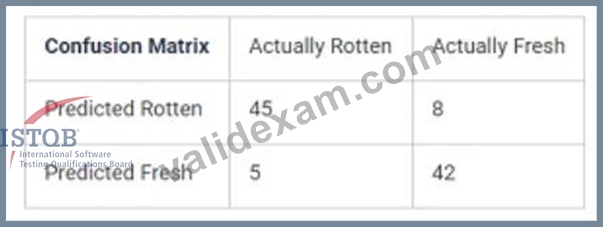
For this confusion matrix which combinations of values of accuracy, recall, and specificity respectively is CORRECT?
SELECT ONE OPTION
- A. 0.84.1,0.9
- B. 0.87.0.9. 0.84
- C. 1,0.87,0.84
- D. 1,0.9, 0.8
Answer: B
Explanation:
To calculate the accuracy, recall, and specificity from the confusion matrix provided, we use the following formulas:
Confusion Matrix:
Actually Rotten: 45 (True Positive), 8 (False Positive)
Actually Fresh: 5 (False Negative), 42 (True Negative)
Accuracy:
Accuracy is the proportion of true results (both true positives and true negatives) in the total population.
Formula: Accuracy=TP+TNTP+TN+FP+FN\text{Accuracy} = \frac{TP + TN}{TP + TN + FP + FN}Accuracy=TP+TN+FP+FNTP+TN Calculation: Accuracy=45+4245+42+8+5=87100=0.87\text{Accuracy} = \frac{45 + 42}{45 + 42 + 8 + 5} = \frac{87}{100} = 0.87Accuracy=45+42+8+545+42=10087=0.87 Recall (Sensitivity):
Recall is the proportion of true positive results in the total actual positives.
Formula: Recall=TPTP+FN\text{Recall} = \frac{TP}{TP + FN}Recall=TP+FNTP Calculation: Recall=4545+5=4550=0.9\text{Recall} = \frac{45}{45 + 5} = \frac{45}{50} = 0.9Recall=45+545=5045=0.9 Specificity:
Specificity is the proportion of true negative results in the total actual negatives.
Formula: Specificity=TNTN+FP\text{Specificity} = \frac{TN}{TN + FP}Specificity=TN+FPTN Calculation: Specificity=4242+8=4250=0.84\text{Specificity} = \frac{42}{42 + 8} = \frac{42}{50} = 0.84Specificity=42+842=5042=0.84 Therefore, the correct combinations of accuracy, recall, and specificity are 0.87, 0.9, and 0.84 respectively.
Reference:
ISTQB CT-AI Syllabus, Section 5.1, Confusion Matrix, provides detailed formulas and explanations for calculating various metrics including accuracy, recall, and specificity.
"ML Functional Performance Metrics" (ISTQB CT-AI Syllabus, Section 5).
NEW QUESTION # 34
......
ISTQB CT-AI Exam Syllabus Topics:
| Topic | Details |
|---|---|
| Topic 1 |
|
| Topic 2 |
|
| Topic 3 |
|
| Topic 4 |
|
| Topic 5 |
|
| Topic 6 |
|
| Topic 7 |
|
| Topic 8 |
|
Pass Your CT-AI Exam Easily With 100% Exam Passing Guarantee: https://www.validexam.com/CT-AI-latest-dumps.html
CT-AI Dumps are Available for Instant Access: https://drive.google.com/open?id=1I1cFwrwCLFTCnoVXBn5THphcw0DDIuIg