


Get 100% Passing Success With True CISSP-ISSMP Exam! [Aug-2026]
ISC CISSP-ISSMP PDF Questions - Exceptional Practice To CISSP-ISSMP - Information Systems Security Management Professional
How to study the CISSP-ISSMP Exam
There are two main types of resources for preparation of certification exams first there are the study guides and the books that are detailed and suitable for building knowledge from ground up then there are video tutorial and lectures that can somehow ease the pain of through study and are comparatively less boring for some candidates yet these demand time and concentration from the learner. Smart Candidates who want to build a solid foundation in all exam topics and related technologies usually combine video lectures with study guides to reap the benefits of both but there is one crucial preparation tool as often overlooked by most candidates the practice exams. Practice exams are built to make students comfortable with the real exam environment. Statistics have shown that most students fail not due to that preparation but due to exam anxiety the fear of the unknown. ValidExam expert team recommends you to prepare some notes on these topics along with it don't forget to practice ISC CISSP-ISSMP exam dumps which been written by our expert team, Both these will help you a lot to clear this exam with good marks.
CISSP-ISSMP Exam topics
Candidates must know the exam topics before they start of preparation. Because it will really help them in hitting the core. Our ISC CISSP-ISSMP exam dumps will include the following topics:
- Law, Ethics, and Security Compliance Management 14%
- Systems Lifecycle Management 19%
- Threat Intelligence and Incident Management 17%
- Leadership and Business Management 22%
NEW QUESTION # 17
Which of the following is a documentation of guidelines that computer forensics experts use to handle evidences?
- A. Chain of evidence
- B. Chain of custody
- C. Evidence access policy
- D. Incident responsepolicy
Answer: B
NEW QUESTION # 18
Which of the following BEST describes the purpose of "segregation of environments" (e.g., dev, test, production)?
- A. To prevent untested or insecure changes from directly impacting production systems and data
- B. To simplify network diagrams
- C. To comply with employee vacation policies
- D. To reduce hardware costs
Answer: A
Explanation:
Separating environments reduces the risk that unstable code, test data, or unauthorized changes affect live production systems, supporting both security and change management.
NEW QUESTION # 19
You work as a security manager for SoftTech Inc. You are conducting a security awareness campaign for your employees. One of the employees of your organization asks you the purpose of the security awareness, training and education program. What will be your answer?
- A. It improves the security of vendor relations.
- B. It improves the possibility for career advancement of the IT staff.
- C. It improves the performance of a company's intranet.
- D. It improves awareness of the need to protect system resources.
Answer: D
Explanation:
The purpose of security awareness, training, and education is to increase security by:
Improving awareness of the need to protect system resources. Enhancing the skills and knowledge so that the computer users can perform their jobs more securely. Constructing in- depth knowledge, as needed, to design, implement, or operate security programs for organizations and systems. Making computer system users aware of their security responsibilities and teaching them correct practices, which helps users change their behavior.
It also supports individual accountability because without the knowledge of the necessary security measures and how to use them, users cannot be truly accountable for their actions. Answer options B, C, and A are incorrect. These are not the valid answers for the above question.
Reference: CISM Review Manual 2010, Contents: "Information Security Program Management"
NEW QUESTION # 20
Which of the following BEST describes the purpose of a Memorandum of Understanding (MOU) in the context of contingency planning?
- A. It documents a general agreement of intent between parties regarding mutual aid or cooperation
- B. It legally binds a vendor to specific service levels
- C. It replaces the need for a formal contract
- D. It guarantees financial compensation in case of disaster
Answer: A
Explanation:
An MOU expresses mutual intent to cooperate (e.g., reciprocal site agreements) but is generally not as legally binding or detailed as a formal contract or SLA. Answer option A describes an SLA; C and D overstate the MOU's legal weight.
NEW QUESTION # 21
Mark works as a security manager for SofTech Inc. He is working in a partially equipped office space which contains some of the system hardware, software, telecommunications, and power sources. In which of the following types of office sites is he working?
- A. Warm site
- B. Hot site
- C. Mobile site
- D. Cold site
Answer: A
NEW QUESTION # 22
A security manager wants to ensure that critical business functions can continue during a disruption with minimal manual intervention. Which BCP strategy addresses this BEST?
- A. Annual tabletop exercises
- B. Employee cross-training
- C. Manual workaround procedures
- D. Redundant/failover systems with automated switchover
Answer: D
Explanation:
Automated redundancy/failover minimizes downtime and manual intervention during disruption.
Answer options A, C, and D support resilience but don't directly provide continuous automated operation.
NEW QUESTION # 23
Which of the following types of evidence is considered as the best evidence?
- A. The original document
- B. A computer-generated record
- C. Information gathered through the witness's senses
- D. A copy of the original document
Answer: A
NEW QUESTION # 24
Drag and drop the various SSE-CMM levels at the appropriate places.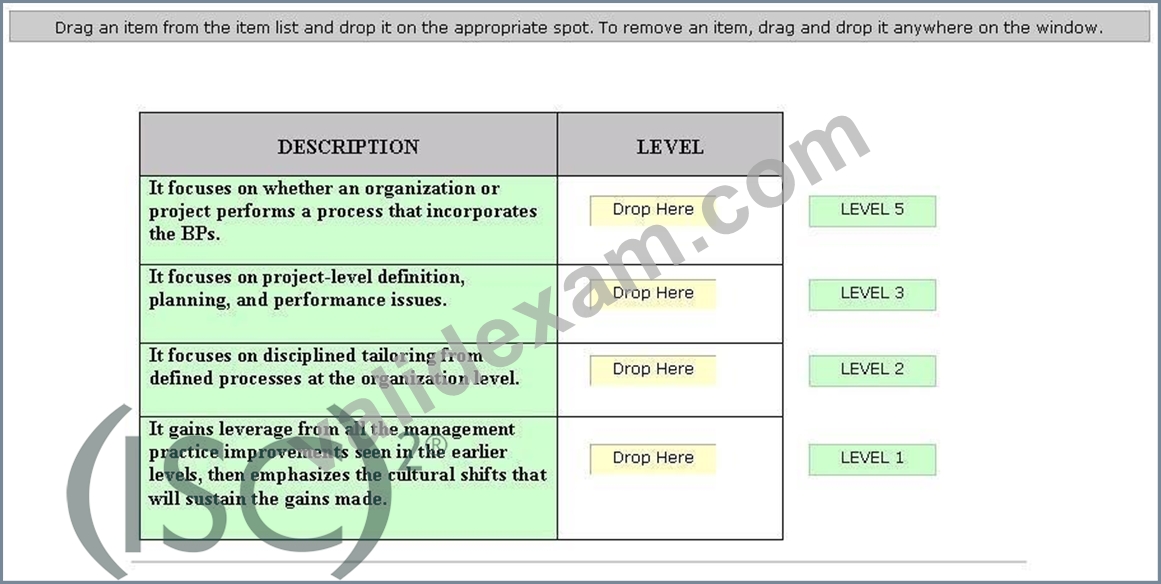
Answer:
Explanation: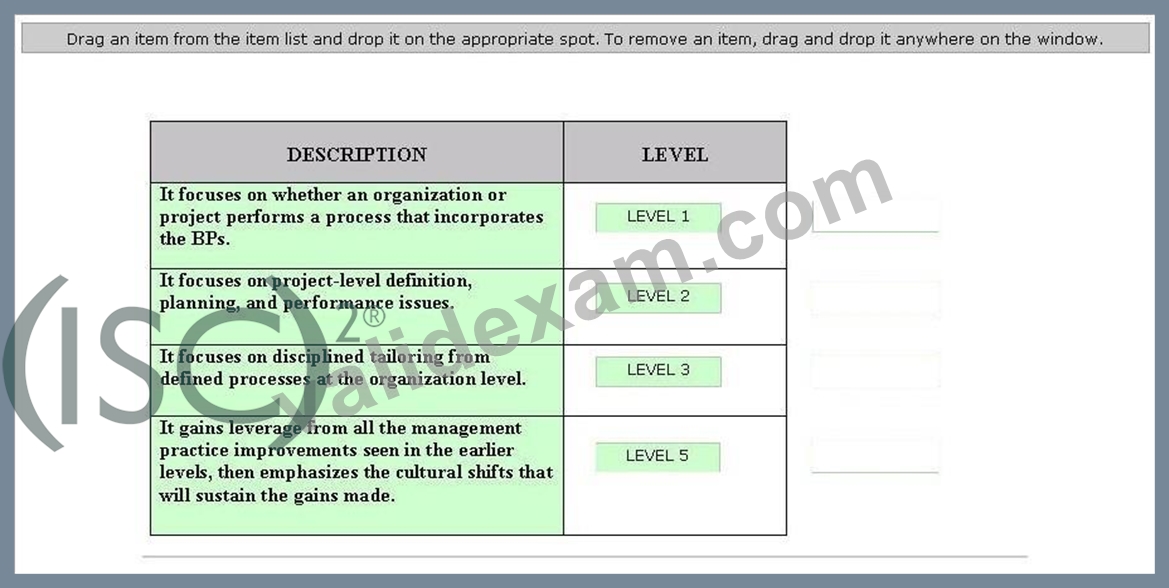
Explanation:
The various SSE-CMM levels are described in the table below.
LEVEL 1 - It focuses on whether an organization or project performs a process that incorporates the BPs. A statement characterizing this level would be, "You have to do it before you can manage it." LEVEL 2 - It focuses on project-level definition, planning, and performance issues. A statement characterizing this level would be, "Understand what's happening on the project before defining organization-wide processes." LEVEL 3 - It focuses on disciplined tailoring from defined processes at the organization level. A statement characterizing this level would be, "Use the best of what you've learned from your projects to create organization-wide processes." LEVEL 4 - It focuses on measurements being tied to the business goals of the organization.
Although it is essential to begin collecting and using basic project measures early, measurement and use of data are not expected organization-wide until the higher levels have been achieved.
Statements characterizing this level would be, "You can't measure it until you know what 'it' is," and "Managing with measurement is meaningful only when you're measuring the right things." LEVEL 5 - It gains leverage from all the management practice improvements seen in the earlier levels, then emphasizes the cultural shifts that will sustain the gains made. A statement characterizing this level would be, "A culture of continuous improvement requires a foundation of sound management practice, defined processes, and measurable goals." Reference: CISM Review Manual 2010, Contents. "Information Security Program Development"
NEW QUESTION # 25
Which of the following is the process performed between organizations that have unique hardware or software that cannot be maintained at a hot or warm site?
- A. Cold sites arrangement
- B. Business impact analysis
- C. Duplicate processing facilities
- D. Reciprocal agreements
Answer: D
NEW QUESTION # 26
You are the Network Administrator for a college. You watch a large number of people (some not even students) going in and out of areas with campus computers (libraries, computer labs, etc.). You have had a problem with laptops being stolen. What is the most cost effective method to prevent this?
- A. Appoint a security guard.
- B. Videosurveillance on all areas with computers.
- C. Smart card access to all areas with computers.
- D. Use laptop locks.
Answer: D
NEW QUESTION # 27
Which of the following is a set of exclusive rights granted by a state to an inventor or his assignee for a fixed period of time in exchange for the disclosure of an invention?
- A. Patent
- B. Snooping
- C. Utility model
- D. Copyright
Answer: A
Explanation:
A patent is a set of exclusive rights granted by a state to an inventor or his assignee for a fixed period of time in exchange for the disclosure of an invention. Answer option D is incorrect. A copyright is a form of intellectual property, which secures to its holder the exclusive right to produce copies of his or her works of original expression, such as a literary work, movie, musical work or sound recording, painting, photograph, computer program, or industrial design, for a defined, yet extendable, period of time. It does not cover ideas or facts. Copyright laws protect intellectual property from misuse by other individuals. Answer option C is incorrect. Snooping is an activity of observing the content that appears on a computer monitor or watching what a user is typing. Snooping also occurs by using software programs to remotely monitor activity on a computer or network device. Hackers or attackers use snooping techniques and equipment such as keyloggers to monitor keystrokes, capture passwords and login information, and to intercept e- mail and other private communications. Sometimes, organizations also snoop their employees legitimately to monitor their use of organizations' computers and track Internet usage.
Answer option B is incorrect. A utility model is an intellectual property right to protect inventions.
Reference: "http://en.wikipedia.org/wiki/Patent"
NEW QUESTION # 28
Which of the following BEST describes why a CISO should maintain relationships with peer organizations and information sharing groups (e.g., ISACs)?
- A. Information sharing is prohibited by law
- B. Peer relationships have no value in incident response
- C. ISACs only serve government agencies
- D. Collaborative threat intelligence sharing improves situational awareness and collective defense across the sector
Answer: D
Explanation:
Information Sharing and Analysis Centers (ISACs) and similar groups allow organizations within a sector to share threat intelligence and best practices, improving early warning and collective resilience against common threats.
NEW QUESTION # 29
Which of the following types of agreement creates a confidential relationship between the parties to protect any type of confidential and proprietary information or a trade secret?
- A. SLA
- B. Non-price competition
- C. NDA
- D. CNC
Answer: C
NEW QUESTION # 30
Which of the following BEST describes why an organization should maintain a documented
"incident response playbook" for specific threat scenarios (e.g., ransomware, business email compromise)?
- A. Playbooks are only useful for compliance audits, not actual response
- B. Scenario-specific playbooks provide detailed, pre-defined action steps tailored to common attack types, improving response speed and consistency
- C. Generic incident response plans are always sufficient for every scenario
- D. Playbooks eliminate the need for analyst judgment entirely
Answer: B
Explanation:
While a general IR plan covers overall process, scenario-specific playbooks (e.g., for ransomware, BEC, DDoS) provide detailed technical and procedural steps tailored to that threat type, enabling faster, more consistent response.
NEW QUESTION # 31
Which of the following access control models are used in the commercial sector? Each correct answer represents a complete solution. Choose two.
- A. Clark-Wilson model
- B. Bell-LaPadula model
- C. Clark-Biba model
- D. Biba model
Answer: A,D
Explanation:
Explanation/Reference:
NEW QUESTION # 32
Which of the following BEST describes why "plan maintenance" (periodic review/update) is required even for a well-tested BCP/DRP?
- A. Once tested successfully, a plan requires no further updates
- B. Plan maintenance is solely an auditor's responsibility
- C. Organizational, technical, and personnel changes over time can render a plan outdated, so it must be periodically reviewed and updated to remain effective
- D. Maintenance is only needed after an actual disaster occurs
Answer: C
Explanation:
Staff turnover, system changes, new vendors, and organizational restructuring can all invalidate previously accurate plan details; periodic review (e.g., annually or after major change) keeps the plan current and actionable.
NEW QUESTION # 33
How can you calculate the Annualized Loss Expectancy (ALE) that may occur due to a threat?
- A. Exposure Factor (EF)/Single Loss Expectancy (SLE)
- B. Asset Value X Exposure Factor (EF)
- C. Single Loss Expectancy (SLE) X Annualized Rate of Occurrence (ARO)
- D. Single Loss Expectancy (SLE)/ Exposure Factor (EF)
Answer: C
NEW QUESTION # 34
......
Who should take the CISSP-ISSMP exam
The ISC Information Systems Security Management Professional certification is an internationally-recognized validation that identifies persons who earn it as possessing skilled as an ISC Information Systems Security Management Professional. If a candidate wants significant improvement in career growth needs enhanced knowledge, skills, and talents. The ISC Information Systems Security Management Professional certification provides proof of this advanced knowledge and skill. If a candidate has knowledge and skills that are required to pass ISC CISSP-ISSMP Exam then he should take this exam.
CISSP-ISSMP dumps - ValidExam - 100% Passing Guarantee: https://www.validexam.com/CISSP-ISSMP-latest-dumps.html