


Get Perfect Results with Premium AZ-500 Dumps Updated 404 Questions
Free AZ-500 Exam Study Guide for the NEW Dumps Test Engine
The benefit in Obtaining the AZ-500 Exam Certification
- Microsoft is the best company that designs the exam AZ-500.
- Pass the AZ-500 exam, land a huge salary.
- Questions from this exam are updated.
- Certification AZ-500 will be used to enhance the career of the candidate.
Microsoft AZ-500 (Microsoft Azure Security Technologies) Certification Exam is an essential certification for professionals seeking to prove their expertise in securing Microsoft Azure environments. Microsoft Azure Security Technologies certification exam is designed to test the candidate's knowledge and skills in implementing security controls, identifying and mitigating security threats, and managing Azure security solutions.
NEW QUESTION # 156
You have an Azure subscription that uses Microsoft Defender for Cloud.
You need to use Defender for Cloud to review regulatory compliance with the Azure CIS 1.4,0 standard. The solution must minimize administrative effort.
What should you do first?
- A. Add a custom initiative.
- B. Assign an Azure policy.
- C. Disable one of the Out of the box standards.
- D. Manually add the Azure CIS 1.4.0 standard.
Answer: B
NEW QUESTION # 157
You are configuring just in time (JIT) VM access to a set of Azure virtual machines.
You need to grant users PowerShell access to the virtual machine by using JIT VM access.
What should you configure? To answer, select the appropriate options in the answer area.
NOTE: Each correct selection is worth one point.
Answer:
Explanation:
NEW QUESTION # 158
You need to deploy Microsoft Antimalware to meet the platform protection requirements.
What should you do? To answer, select the appropriate options in the answer area.
NOTE: Each correct selection is worth one point.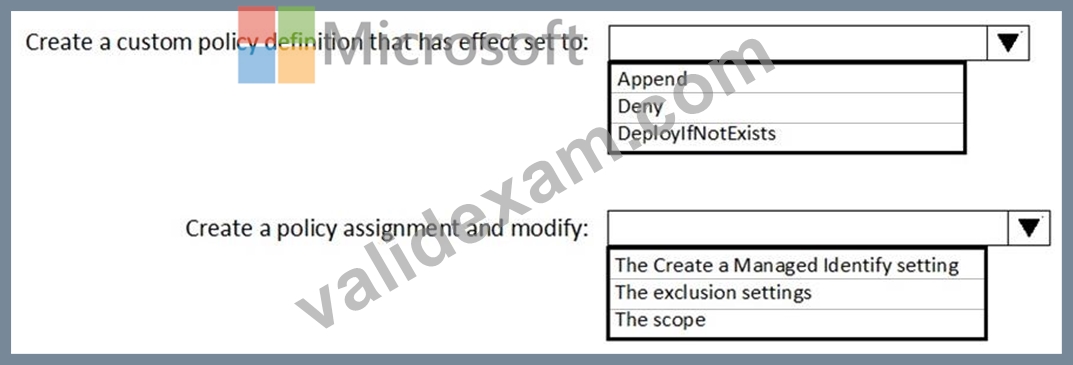
Answer:
Explanation:
NEW QUESTION # 159
You have an Azure subscription that contains a user named User1 and a storage account named storage1. The storage1 account contains the resources shown in the following table.
In storage1, you create a shared access signature (SAS) named SAS1 as shown in the following exhibit.
To which resources can User! write on July 1, 2022 by using SAS1 and key 1? To answer, select the appropriate options in the answer area. NOTE: Each correct selection is worth one point.
Answer:
Explanation:
Explanation
NEW QUESTION # 160
You have an Azure Active Directory (Azure AD) tenant named contoso.com that contains the users shown in the following table.
You create and enforce an Azure AD Identity Protection user risk policy that has the following settings:
* Assignment: Include Group1, Exclude Group2
* Conditions: Sign-in risk of Medium and above
* Access: Allow access, Require password change
For each of the following statements, select Yes if the statement is true. Otherwise, select No.
NOTE: Each correct selection is worth one point.
Answer:
Explanation:
Explanation:
Box 1: Yes
User1 is member of Group1. Sign in from unfamiliar location is risk level Medium.
Box 2: Yes
User2 is member of Group1. Sign in from anonymous IP address is risk level Medium.
Box 3: No
Sign-ins from IP addresses with suspicious activity is low.
Note:
Azure AD Identity protection can detect six types of suspicious sign-in activities:
* Users with leaked credentials
* Sign-ins from anonymous IP addresses
* Impossible travel to atypical locations
* Sign-ins from infected devices
* Sign-ins from IP addresses with suspicious activity
* Sign-ins from unfamiliar locations
These six types of events are categorized in to 3 levels of risks - High, Medium & Low:
References:
http://www.rebeladmin.com/2018/09/step-step-guide-configure-risk-based-azure-conditional-access-policies/
NEW QUESTION # 161
Note: This question is part of a series of questions that present the same scenario. Each question in the series contains a unique solution that might meet the stated goals. Some question sets might have more than one correct solution, while others might not have a correct solution.
After you answer a question in this section, you will NOT be able to return to it. As a result, these questions will not appear in the review screen.
You use Azure Security Center for the centralized policy management of three Azure subscriptions.
You use several policy definitions to manage the security of the subscriptions.
You need to deploy the policy definitions as a group to all three subscriptions.
Solution: You create an initiative and an assignment that is scoped to a management group.
Does this meet the goal?
- A. Yes
- B. No
Answer: A
Explanation:
Reference:
https://docs.microsoft.com/en-us/azure/governance/policy/overview
NEW QUESTION # 162
You have an Azure Active Directory (Azure AD) tenant that contains the users shown in the following table.
From Azure AD Privileged Identity Management (PIM), you configure the settings for the Security Administrator role as shown in the following exhibit.
From PIM, you assign the Security Administrator role to the following groups:
Group1: Active assignment type, permanently assigned
Group2: Eligible assignment type, permanently eligible
For each of the following statements, select Yes if the statement is true. Otherwise, select No.
NOTE: Each correct selection is worth one point.
Answer:
Explanation:
Explanation
Box 1: Yes
Eligible Type: A role assignment that requires a user to perform one or more actions to use the role. If a user has been made eligible for a role, that means they can activate the role when they need to perform privileged tasks. There's no difference in the access given to someone with a permanent versus an eligible role assignment. The only difference is that some people don't need that access all the time.
You can choose from two assignment duration options for each assignment type (eligible and active) when you configure settings for a role. These options become the default maximum duration when a user is assigned to the role in Privileged Identity Management.
Use the Activation maximum duration slider to set the maximum time, in hours, that a role stays active before it expires. This value can be from one to 24 hours.
Box 2: Yes
Active Type: A role assignment that doesn't require a user to perform any action to use the role. Users assigned as active have the privileges assigned to the role Box 3: Yes User3 is member of Group2.
Reference:
https://docs.microsoft.com/en-us/azure/active-directory/privileged-identity-management/pim-configure
https://docs.microsoft.com/bs-cyrl-ba/azure/active-directory/privileged-identity-management/pim-resource-role
NEW QUESTION # 163
You have an Azure subscription that contains the resources shown in the following table.
Transparent Data Encryption (TDE) is disabled on SQL1.
You assign polices to the resource groups as shown in the following table.
You plan to deploy Azure SQL databases by using an Azure Resource Manager (ARM) template. The databases will be configured as shown in the following table.
NOTE: Each correct selection is worth one point.
Answer:
Explanation:
NEW QUESTION # 164
You are evaluating the security of the network communication between the virtual machines in Sub2.
For each of the following statements, select Yes if the statement is true. Otherwise, select No.
NOTE: Each correct selection is worth one point.
Answer:
Explanation:
NEW QUESTION # 165
Your company has an Azure subscription named Subscription1 that contains the users shown in the following table.
The company is sold to a new owner.
The company needs to transfer ownership of Subscription1.
Which user can transfer the ownership and which tool should the user use? To answer, select the appropriate options in the answer area.
NOTE: Each correct selection is worth one point.
Answer:
Explanation:
Explanation
Box 1; User2
Billing Administrator
Select Transfer billing ownership for the subscription that you want to transfer.
Enter the email address of a user who's a billing administrator of the account that will be the new owner for the subscription.
Box 2: Azure Account Center
Azure Account Center can be used.
Reference:
https://docs.microsoft.com/en-us/azure/billing/billing-subscription-transfer#transfer-billing-ownership-of-an-azu
NEW QUESTION # 166
You are implementing conditional access policies.
You must evaluate the existing Azure Active Directory (Azure AD) risk events and risk levels to configure and implement the policies.
You need to identify the risk level of the following risk events:
Users with leaked credentials
Impossible travel to atypical locations
Sign ins from IP addresses with suspicious activity
Which level should you identify for each risk event? To answer, drag the appropriate levels to the correct risk events. Each level may be used once, more than once, or not at all. You may need to drag the split bar between panes or scroll to view content.
NOTE: Each correct selection is worth one point.
Answer:
Explanation:
NEW QUESTION # 167
HOTSPOT
You have an Azure Active Directory (Azure AD) tenant that contains the users shown in the following table.
You create and enforce an Azure AD Identity Protection sign-in risk policy that has the following settings:
Assignments: Include Group1, exclude Group2
Conditions: Sign-in risk level: Medium and above
Access Allow access, Require multi-factor authentication
You need to identify what occurs when the users sign in to Azure AD.
What should you identify for each user? To answer, select the appropriate options in the answer area.
NOTE: Each correct selection is worth one point.
Hot Area:
Answer:
Explanation:
Explanation/Reference:
References:
http://www.rebeladmin.com/2018/09/step-step-guide-configure-risk-based-azure-conditional-access-policies/
https://docs.microsoft.com/en-us/azure/active-directory/identity-protection/concept-identity-protection-policies
https://docs.microsoft.com/en-us/azure/active-directory/identity-protection/concept-identity-protection-risks Implement platform protection Testlet 1 This is a case study. Case studies are not timed separately. You can use as much exam time as you would like to complete each case. However, there may be additional case studies and sections on this exam. You must manage your time to ensure that you are able to complete all questions included on this exam in the time provided.
To answer the questions included in a case study, you will need to reference information that is provided in the case study. Case studies might contain exhibits and other resources that provide more information about the scenario that is described in the case study. Each question is independent of the other question on this case study.
At the end of this case study, a review screen will appear. This screen allows you to review your answers and to make changes before you move to the next sections of the exam. After you begin a new section, you cannot return to this section.
To start the case study
To display the first question on this case study, click the Next button. Use the buttons in the left pane to explore the content of the case study before you answer the questions. Clicking these buttons displays information such as business requirements, existing environment, and problem statements. If the case study has an All Information tab, note that the information displayed is identical to the information displayed on the subsequent tabs. When you are ready to answer a question, click the Question button to return to the question.
Overview
Litware, Inc. is a digital media company that has 500 employees in the Chicago area and 20 employees in the San Francisco area.
Existing Environment
Litware has an Azure subscription named Sub1 that has a subscription ID of 43894a43-17c2-4a39-8cfc-
3540c2653ef4.
Sub1 is associated to an Azure Active Directory (Azure AD) tenant named litwareinc.com. The tenant contains the user objects and the device objects of all the Litware employees and their devices. Each user is assigned an Azure AD Premium P2 license. Azure AD Privileged Identity Management (PIM) is activated.
The tenant contains the groups shown in the following table.
The Azure subscription contains the objects shown in the following table.
Identity and Access Requirements
Azure Security Center is set to the Standard tier.
Requirements
Planned changes
Litware plans to deploy the Azure resources shown in the following table.
Litware identifies the following identity and access requirements:
* All San Francisco users and their devices must be members of Group1.
* The members of Group2 must be assigned the Contributor role to Resource Group2 by using a permanent eligible assignment.
* Users must be prevented from registering applications in Azure AD and from consenting to applications that access company information on the users' behalf.
Platform Protection Requirements
Litware identifies the following platform protection requirements:
* Microsoft Antimalware must be installed on the virtual machines in Resource Group1.
* The members of Group2 must be assigned the Azure Kubernetes Service Cluster Admin Role.
* Azure AD users must be to authenticate to AKS1 by using their Azure AD credentials.
* Following the implementation of the planned changes, the IT team must be able to connect to VM0 by using JIT VM access.
* A new custom RBAC role named Role1 must be used to delegate the administration of the managed disks in Resource Group1. Role1 must be available only for Resource Group1.
Security Operations Requirements
Litware must be able to customize the operating system security configurations in Azure Security Center.
Data and Application Requirements
Litware identifies the following data and applications requirements:
* The users in Group2 must be able to authenticate to SQLDB1 by using their Azure AD credentials.
* WebApp1 must enforce mutual authentication.
General Requirements
Litware identifies the following general requirements:
* Whenever possible, administrative effort must be minimized.
* Whenever possible, use of automation must be maximized.
NEW QUESTION # 168
You need to configure SQLDB1 to meet the data and application requirements.
Which three actions should you recommend be performed in sequence? To answer, move the appropriate actions from the list of actions to the answer area and arrange them in the correct order.
Answer:
Explanation:
Explanation
Step 1: Connect to SQLDB1 by using Microsoft SQL Server Management Studio (SSMS) Step 2: In SQLDB1, create contained database users.
Create a contained user in the database that represents the VM's system-assigned identity.
Step 3: In Azure AD,create a system-assigned managed identity.
A system-assigned identity for a Windows virtual machine (VM) can be used to access an Azure SQL server.
Managed Service Identities are automatically managed by Azure and enable you to authenticate to services that support Azure AD authentication, without needing to insert credentials into your code.
References:
https://docs.microsoft.com/en-us/azure/active-directory/managed-identities-azure-resources/tutorial-windows-vm
Topic 1, Litware, inc
This is a case study. Case studies are not timed separately. You can use as much exam time as you would like to complete each case. However, there may be additional case studies and sections on this exam. You must manage your time to ensure that you are able to complete all questions included on this exam in the time provided.
To answer the questions included in a case study, you will need to reference information that is provided in the case study. Case studies might contain exhibits and other resources that provide more information about the scenario that is described in the case study. Each question is independent of the other question on this case study.
At the end of this case study, a review screen will appear. This screen allows you to review your answers and to make changes before you move to the next sections of the exam. After you begin a new section, you cannot return to this section.
To start the case study
To display the first question on this case study, click the Next button. Use the buttons in the left pane to explore the content of the case study before you answer the questions. Clicking these buttons displays information such as business requirements, existing environment, and problem statements. If the case study has an All Information tab, note that the information displayed is identical to the information displayed on the subsequent tabs. When you are ready to answer a question, click the Question button to return to the question.
Overview
Litware, Inc. is a digital media company that has 500 employees in the Chicago area and 20 employees in the San Francisco area.
Existing Environment
Litware has an Azure subscription named Sub1 that has a subscription ID of
43894a43-17c2-4a39-8cfc-3540c2653ef4.
Sub1 is associated to an Azure Active Directory (Azure AD) tenant named litwareinc.com. The tenant contains the user objects and the device objects of all the Litware employees and their devices. Each user is assigned an Azure AD Premium P2 license. Azure AD Privileged Identity Management (PIM) is activated.
The tenant contains the groups shown in the following table.
The Azure subscription contains the objects shown in the following table.
Azure Security Center is set to the Free tier.
Planned changes
Litware plans to deploy the Azure resources shown in the following table.
Litware identifies the following identity and access requirements:
* All San Francisco users and their devices must be members of Group1.
* The members of Group2 must be assigned the Contributor role to Resource Group2 by using a permanent eligible assignment.
* Users must be prevented from registering applications in Azure AD and from consenting to applications
* that access company information on the users' behalf.
Platform Protection Requirements
Litware identifies the following platform protection requirements:
* Microsoft Antimalware must be installed on the virtual machines in Resource Group1.
* The members of Group2 must be assigned the Azure Kubernetes Service Cluster Admin Role.
* Azure AD users must be to authenticate to AKS1 by using their Azure AD credentials.
* Following the implementation of the planned changes, the IT team must be able to connect to VM0 by using JIT VM access.
* A new custom RBAC role named Role1 must be used to delegate the administration of the managed disks in Resource Group1. Role1 must be available only for Resource Group1.
Security Operations Requirements
Litware must be able to customize the operating system security configurations in Azure Security Center.
NEW QUESTION # 169
You have an Azure subscription that contains the storage accounts shown in the following table.
You need to configure authorization access.
Which authorization types can you use for each storage account? To answer, select the appropriate options in the answer area.
NOTE: Each correct selection is worth one point.
Answer:
Explanation:
Reference:
https://docs.microsoft.com/en-us/azure/storage/common/authorize-data-access
NEW QUESTION # 170
You work at a company named Contoso, Ltd. that has the offices shown in the following table.
Contoso has an Azure Active Directory (Azure AD) tenant named contoso.com. All contoso.com users have Azure Multi-Factor Authentication (MFA) enabled. The tenant contains the users shown in the following table.
The multi-factor settings for contoso.com are configured as shown in the following exhibit.
For each of the following statements, select Yes if the statement is true. Otherwise, select No.
NOTE: Each correct selection is worth one point.
Answer:
Explanation:
Explanation
NEW QUESTION # 171
You have an Azure subscription that contains a blob container named cont1. Cont1 has the access policies shown in the following exhibit.
Use the drop-down menus to select the answer choice that completes each statement based on the information presented in the graphic.
Answer:
Explanation:
NEW QUESTION # 172
You have a management group named Group1 that contains an Azure subscription named sub1. Sub1 has a subscription ID of 11111111-1234-1234-1234-1111111111.
You need to create a custom Azure role-based access control (RBAC) role that will delegate permissions to manage the tags on all the objects in Group1.
What should you include in the role definition of Role1? To answer, select the appropriate options in the answer area.
NOTE: Each correct selection is worth one point.
Answer:
Explanation:
Reference:
https://docs.microsoft.com/en-us/azure/role-based-access-control/resource-provider-operations
https://docs.microsoft.com/en-us/azure/role-based-access-control/custom-roles
https://docs.microsoft.com/en-us/azure/role-based-access-control/custom-roles-portal#step-5-assignable-scopes
NEW QUESTION # 173
......
AZ-500 PDF Dumps Extremely Quick Way Of Preparation: https://www.validexam.com/AZ-500-latest-dumps.html
Download AZ-500 Dumps (2024) - Free PDF Exam Demo: https://drive.google.com/open?id=1C4vo8f5cV8stK206S_djaSsPBZWJuh5X