


[Full-Version] 2021 New ValidExam 301 PDF Recently Updated Questions
301 Exam with Guarantee Updated 49 Questions
Certification Path of 301a - LTM Technology Specialist
Acquiring the F5-CTS LTM accreditation requires breezing through two tests â BIG-IP LTM Specialist: Architect, Setup, and Deploy (Exam 301a) and BIG-IP LTM Specialist: Maintain and Troubleshoot (Exam 301b).
Understanding technical and functional aspects of LTM Specialist
The following will be discussed in F5 301 dumps:
- Describe the cycle to refresh lapsed SSL endorsements
- Given an application arrangement, figure out what capacities can be offloaded to the LTM gadget
- Explain how to offload HTTP workers for SSL pressure and reserving
- Explain how to make a HTTP arrangement for versatile customers
- Determine under which conditions an outside screen is required
- Explain CARP ingenuity
- Given a bunch of SSL necessities, decide the fitting profile choices to make or alter in the SSL profile
- Explain how to perform outbound burden adjusting
- Explain how to make a HTTP arrangement to upgrade WAN network
- Describe which steps are important to finish preceding making the virtual worker
- Describe the contrast among customer and worker SSL profiles
- Explain the impact of LTM gadget design boundaries on load adjusting choices
- Describe how a given assistance is conveyed on a LTM
- Given a bunch of use prerequisites, decide the suitable virtual worker arrangement settings
- Explain how to make an AVR profile and alternatives
- Describe the advantage of utilizing SNAT pools
- Explain how to make an application explicit screen
- Differentiate distinctive burden adjusting techniques
- Given a bunch of use prerequisites, decide the suitable virtual worker type to utilize
- Explain when SNAT is required
- Given an application arrangement, decide the suitable profile and determination choices
- Given a bunch of announcing prerequisites, decide the AVR measurements and substances to gather
- Given an ideal result, figure out where to apply wellbeing screens
- Given a situation, decide the base profiles for an application
- Explain how to utilize LTM as an assistance intermediary
- Explain the logging and warnings alternatives of AVR
- Identify the conduct of the application to be load adjusted
- Explain security alternatives accessible for the application
- Describe the security alternatives while making a virtual worker (i.e., VLAN constraint, course spaces, bundle channels, iRules)
- Explain the coordinating with request of numerous virtual workers U/A
- Describe the means to consolidate customer validation to the SSL interaction
- Determine when association reflecting is required
- Explain the employments of the gathered measurements and substances
- Explain the estimating ramifications of AVR on the LTM gadget
- Explain the means important to arrange AVR
- Determine the impact of a screen on the virtual worker status
- Given a situation, decide the fitting burden adjusting method(s) U/A
- Explain the means important to arrange the AVR
- Explain how to make a HTTP arrangement to deal with a HTTP worker mistake
- Given a bunch of boundaries, anticipate a result of a screen status on other LTM gadget objects
- Determine the impact of dynamic versus inline screens on the application status or on the LTM gadget
- Given a bunch of use prerequisites, depict the means important to design SSL
- Describe the contrast among customer and worker SSL preparing
- Given a situation, decide the fitting screen type and boundaries to utilize
- Describe the means to consolidate customer validation to the SSL interaction
- Given a normal traffic volume, decide the suitable SNAT setup
- Describe the cycle to refresh lapsed SSL endorsements
- Given an application arrangement, figure out what capacities can be offloaded to the LTM gadget
NEW QUESTION 11
An LTM has the 3 virtual servers, 2 SNATs, four self IP addresses defined and the networks shown in the graphic below. Selected options for each object are shown below. Settings not shown are at their defaults.
Assume port exhaustion has not been reached. VirtualServerl Destination: 10.10.2.102:80 netmask 255.255.255.255 Pool: Pool with 3 members in the 172.16/16 network SNAT Automap configured VirtualServer2 Destination: 10.10.2.102:* netmask 255.255.255.255 Pool: Pool with 3 members in the 192.168/16 network VirtualServer3 Destination: 10.10.2.0:80 netmask 255.255.255.0 Type: IP Forwarding SNATI Source IP: 10.10.0.0 netmask 255.255.0.0 SNATAddress: SNAT Pool with 2 members- 172.16.20.50 and 192.168.10.50 SNAT2 Source IP: All Addresses SNAT Address: 10.10.2.102 Floating Self IPs 192.168.1.1; 172.16.1.1; 10.10.2.1; 10.10.1.1 A connection attempt is made with a source IP and port of 10.20.10.50:2222 and a destination IP and port of 10.10.2.102:80. When the request is processed, what will be the source and destination IP addresses?
- A. Source IP: 10.20.10.50; Destination IP: pool member in the 172.16/16 network
- B. Source IP: 182.16.1.1; Destination IP: pool member in the 172316/16 network
- C. Source IP: 192.168.1.1; Destination IP: pool member in the 192.168/16 network
- D. Source IP: 192.168.10.50; Destination IP: pool member in the 192.168./16 network
- E. Source IP: 172316.20.50; Destination IP: pool member in the 182.16/16 network
- F. The request will be dropped.
- G. Source IP: 10.20.10.50; Destination IP: pool member in the 192.168/16 network
- H. Source IP: 192.168.10.50; Destination IP: pool member in the 192.168/16 network
Answer: B
NEW QUESTION 12
What occurs when a load?command is issued?What occurs when a ? load?command is issued?
- A. rootbigipsystem[Active][tmos.Itm.pool]#create pooh members add {172.16.20.1:80{priority- group 2}}
- B. rootbigipsystem[Active][tmos.Itm.pool]#create pooh members add {172.16.20.1:80}
- C. rootbigipsystem[Active][tmos.Itm.pool]#create pooh members add {172.16.20.1:80{} }
- D. rootbigipsystem[Active][tmos.Itm.pool]#create pooh members add {170.16.20.1:80}
Answer: D
NEW QUESTION 13
Which two processes are involved when BIG-IP systems issue traps? (Choose two.)
- A. smtpd
- B. bigd
- C. syslog-ng
- D. alertd
Answer: C,D
NEW QUESTION 14
An LTM has the 3 virtual servers, a SNAT, four self IP addresses defined and the networks shown in the exhibit. Selected options for each object are shown below. Settings not shown are at their defaults. VirtualServerl Destination: 10.10.2.102:80 netmask 255.255.255.255 Pool: Pool with 3 members in the 172.16/16 network VirtualServer2 Destination: 10.10.2.102:* netmask 255.255.255.255 Pool: Pool with 3 members in the 192.168/16 network VirtualServer3 Destination: 10.10.2.0:80 netmask 255.255.255.0 Type: IP Forwarding SNAT1 Source IP: All Addresses SNATAddress: SNAT Pool with 2 members- 172.16.20.50 and 192.168.10.50 Self IPs 192.168.1.1; 172.16.1.1; 10.10.2.1; 10.10.1.1 A connection attempt is made with a source IP and port of 10.20.100.50:2222 and a destination IP and port of 10.10.2.10:80. When the request is processed, what will be the destination IP address?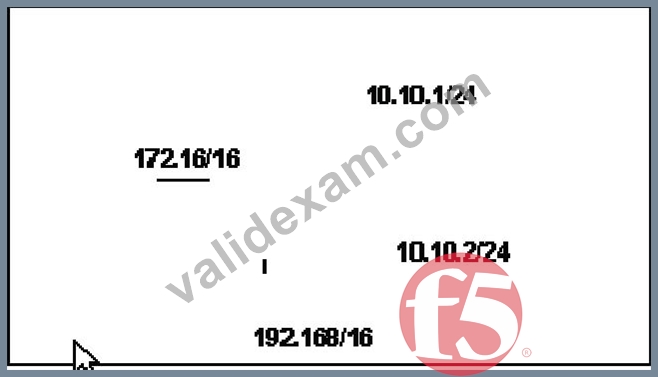
- A. Destination IP: pool member in the 172.16/16 network
- B. Destination IP: pool member in the 192.168/16 network.
- C. The request will be dropped.
- D. Destination IP: 10.10.2.10
Answer: D
NEW QUESTION 15
Which persistence method will always recognize a client when the client returns to the same virtual server?
- A. MSRDP
- B. expression [universal]
- C. source address
- D. No persistence method work in all situations.
- E. SSL
Answer: D
NEW QUESTION 16
Which statement concerning virtual servers is true?
- A. Virtual servers cannot perform load balancing without performing address translation.
- B. Virtual servers can reuse connections between the BIG-IP and server for multiple HTTP GETs.
- C. Virtual servers can keep idle server connections open indefinitely.
- D. Virtual servers can compress data between the BIG-IP and servers.
- E. Virtual server processing always translates the virtual server address to the address of the chosen pool member.
Answer: B
NEW QUESTION 17
Which statement is true concerning packet filters?
- A. Filters cannot prevent access to the management port.
- B. In addition to administrator-created filters, three always exists a "deny all" filter that processes traffic last.
- C. The order of filters does not affect which traffic is accepted or denied
- D. Filters cannot prevent the BIG_IP synching process from taking place.
Answer: A
NEW QUESTION 18
Which three statements are true about SNATs? (Choose three.)
- A. SNAT addresses can be identical to virtual server IP addresses.
- B. SNAT s provide bi-directional traffic initiation.
- C. SNAT s support UDP, TCP, and ICMP traffic.
C, SNAT s provide a many-to-one mapping between IP addresses.
Answer: A,C
NEW QUESTION 19
Which two statements are true concerning capabilities of current BIG-IP platforms?
(Choose two.)
- A. Only 2U BIG-IP Platform have an option of a second power supply.
- B. All current BIG-IP platform use both an ASIC. And CPU(s)to process traffic.
- C. All current BIG-IP platform can perform hardware compression.
- D. All BIG-IP have capacity to perform bulk encryption I decryption of SSL traffic independent of the CPU.
- E. The 1600 hosts more ports than the 3900.
Answer: B,D
NEW QUESTION 20
A monitor has been defined with an alias port of 443. All other options are left at their defaults. The administrator
wishes to assign it to a pool of members where the members' ports vary. Which is the result?
- A. For each member, the monitor will test member node at port 443. For each member, the monitor will test the member ? node at port 443.
- B. This assignment is not allowed since the port do not match.
- C. For each member. If it is running an SSL service at the member port, the monitor may work. Otherwise, the monitor will fail and the member for each member, if it is running an SSL service at the member port, the monitor may work. Otherwise, the monitor will fail and the member will be marked down.
- D. For each member, if the member port is not 443, the member will be marked down. For each member,if the member? Port is not 443, the member will be marked down.
Answer: A
NEW QUESTION 21
What is the expected difference between two source address persistence profiles if profile A has a mask of 255.255.255.0 and profile B has a mask of 255.255.0.0?
- A. Profile A will have more clients matching existing persistence records.
- B. Profile B has a greater potential number of persistence records.
- C. There are no detectable differences.
- D. Profile B will have fewer persistence records for the sane client base.
Answer: D
NEW QUESTION 22
An LTM has the 3 virtual servers, 2 SNATs, four self IP addresses defined, and the networks shown in the exhibit. Selected options for each object are shown below. Settings not shown are at their defaults.
Assume port exhaustion has not been reached. Vi rtualServerl Destination: 10.10.2.102:80 netmask 255.255.255.255 Pool: Pool with 3 members in the 172.16/16 network SNAT Automap configured Vi rtualServer2 Destination: 10.10.2.102:* netmask 255.255.255.255 Pool: Pool with 3 members in the 192.168/16 network Vi rtualServer3 Destination: 10.10.2.0:80 netmask 255.255.255.0 Type: IP Forwarding SNAT1 Source IP: 10.10.0.0 netmask 255.255.0.0 SNAT Address: SNAT Pool with 2 members
172.16.20.50 and 192.168.10.50 SNAT2 Source IP: All Addresses SNATAddress:
10.10.2.102 Floating Self IPs 192.168.1.1; 172.16.1.1; 10.10.2.1; 10.10.1.1
- A. Source IP: 10.10.2.1; Destination IP: 10.10.2.10
- B. Source IP: Either 172.16.20.50 or 192.168.10.50; Destination IP: 10.10.2.10
- C. connection attempt is made with a source IP and port of 10.10.100.50:2222 and a destination IP and port of 10.10.2.10:80. When the request is processed, what will be the source and destination IP addresses?

- D. Source IP: 10.10.2.1; Destination IP: pool in the 172.16/16 network C
- E. The request will be droped.
- F. Source IP: 10.10.2.102; Destination IP 10.10.2.10
Answer: B
NEW QUESTION 23
A BIG-IP has the following objects configured: A SNAT pool with 2 members:
150.10.33.33 and 10.10.1.33 A load-balancing pool with 5 members:
10.10.1.1-10.10.1.5:80
The BIG-IP has two self-IP addresses: 150.10.10.10 and 10.10.1.10 A virtual server at 150.10.30.30:80 that is associated with both the SNAT pool and the load-balancing pool. If a client at IP address 200.10.10.10 initiates a connection to the virtual server, what will the source IP address be in the packets sent to the chosen pool member?
- A. 150.10.30.30
- B. 10.10.1.33
- C. 150.10.33.33
- D. 200.10.10.10
- E. It could be any of the addresses of the members of the load-balancing pool.
- F. 10.10.1.10
Answer: B
NEW QUESTION 24
How is traffic flow through transparent virtual servers different from typical virtual servers?
- A. the value in the tcp acknowledgement field
- B. an IP address
- C. any text string within a cookie
- D. any bytes within the initial client request packet
Answer: B,C
NEW QUESTION 25
What occurs when a load?command is issued?What occurs when a ? load?command is issued?
- A. The running configuration is compared to the configuration in files and, when changes are noted, the version in the files is loaded over what is in money.
- B. the running configuration is replaced by the configuration in the files, but only if they are syntactically correct.
- C. The running configuration is loaded into files for storage.
- D. The running configuration is replaced by the any portion of the configuration files that are syntactically correct.
Answer: B
NEW QUESTION 26
After editing and saving changes to the configuration file containing virtual servers,
what is the immediate result?
- A. The new configuration is verified and loaded.
- B. The new configuration is loaded but not verified.
- C. The new configuration is verified
- D. The new configuration is verified not loaded.
- E. The new configuration is verified and loaded if is it syntactically correct.
- F. The new configuration is neither verified nor loaded.
Answer: F
NEW QUESTION 27
A monitor has been defined using the HTTP monitor template. The send and receive strings were customized, but all other settings were left at their defaults. Which resources can the monitor be assigned to?
- A. only specific pool members
- B. most nodes
- C. most virtual severs
- D. most pools
Answer: D
NEW QUESTION 28
QUESTION NO: 34. Click the Exhibit Button an LTM has the 3 virtual servers, a SNAT defined, four self IP addresses defined and the networks shown in the exhibit. Selected options for each object are shown below. Settings not shown are at their defaults. VirtualServer 1 Destination: 10.10.1.102:80 netmask 255.255.255.255 Pool: Pool with 3 members in the 172.16/16 network SNAT Automap enabled VirtualServer2 Destination: 10.10.1.102:* netmask 255.255.255.255 Pool: Pool with 3 members in the 192.168/16 network VirtualServer 3 Destination: 10.10.2.0:80 netmask 255.255.255.0 Type: IP Forwarding SNATI Source IP: All Addresses SNAT Address: SNAT Pool with 2 members -
172.16.20.50 and
192.168.10.50 Self IPs 192.168.1.1; 172.16.1.1; 10.10.2.1; 10.10.1.1 A connection attempt is made with a source IP and port of 10.20.100.50:80 and a destination IP and port of 10.10.2.10:80. When the request is processed, what will be the source and destination IP addresses?
- A. Source IP: 10.10.2.1; Destination IP: 10.10.2.10
- B. Source IP: Either 172.16.20.50 or 192.168.10.50; Destination IP: 10.10.2010
- C. Source IP: 10.20.100.50; Destination IP: 10.10.2.10
- D. The request will be dropped.
Answer: B
NEW QUESTION 29
A BIG-IP has the following objects configured: A SNAT pool with 2 members: 150.10.33.33 and 10.10.1.33 A load-balancing pool with 5 members: 10.10.1.1-10.10.1.5:80
The BIG-IP has two self-IP addresses: 150.10.10.10 and 10.10.1.10 A virtual server at 150.10.30.30:80 that is associated with both the SNAT pool and the load-balancing pool. If a client at IP address 200.10.10.10 initiates a connection to the virtual server, what will the source IP address be in the packets sent to the chosen pool member?
- A. 150.10.30.30
- B. 10.10.1.33
- C. 150.10.33.33
- D. 200.10.10.10
- E. It could be any of the addresses of the members of the load-balancing pool.
- F. 10.10.1.10
Answer: B
NEW QUESTION 30
......
How to book the 301a - LTM Technology Specialist
These are following steps for registering the 301a - LTM Technology Specialist:
- Step 1 : Signup/Login to F5 account
- Step 2 : Search for F5 301 LTM Certifications Exam
- Step 3 : Select Date and Center of examination and confirm with payment
Latest 301 Pass Guaranteed Exam Dumps Certification Sample Questions: https://www.validexam.com/301-latest-dumps.html