


[Dec 12, 2021] CKA Exam Dumps 100% Same Q&A In Your Real Exam
CKA Test Engine Dumps Training With 63 Questions
Linux Foundation CKA Exam Syllabus Topics:
| Topic | Details |
|---|---|
| Topic 1 |
|
| Topic 2 |
|
| Topic 3 |
|
| Topic 4 |
|
| Topic 5 |
|
| Topic 6 |
|
| Topic 7 |
|
| Topic 8 |
|
| Topic 9 |
|
| Topic 10 |
|
NEW QUESTION 19
Create a redis pod, and have it use a non-persistent storage
Note: In exam, you will have access to kubernetes.io site,
Refer : https://kubernetes.io/docs/tasks/configure-pod-container/configurevolume-storage/
- A. apiVersion: v1
kind: Pod
metadata:
name: redis
spec:
containers:
- name: redis
image: redis
volumeMounts:
- containerPort: 6379
volumes:
- name: redis-storage
emptyDir: {} - B. apiVersion: v1
kind: Pod
metadata:
name: redis
spec:
containers:
- name: redis
image: redis
volumeMounts:
- name: redis-storage
mountPath: /data/redis
ports:
- containerPort: 6379
volumes:
- name: redis-storage
emptyDir: {}
Answer: B
NEW QUESTION 20
Delete persistent volume and persistent volume claim
Answer:
Explanation:
kubectl delete pvc task-pv-claim kubectl delete pv task-pv-volume // Verify Kubectl get pv,pvc
NEW QUESTION 21
From the pod labelname=cpu-utilizer, find podsrunning high CPU workloads and write the name of the pod consumingmost CPU to thefile/opt/KUTR00102/KUTR00102.txt(which already exists).
Answer:
Explanation:
See the solution below.
Explanation
solution

NEW QUESTION 22
Create a redis pod and mount "redis-config" as "redis.conf"
inside redis container, name the config volume as "redis-volume"
redis-config path - /opt/redis-config
- A. 0
- B. 1
- C. Pending
Answer: C
NEW QUESTION 23
Create a persistent volume with name app-data, of capacity 2Gi and access mode ReadWriteMany. The type of volume is hostPath and its location is /srv/app-data.
Answer:
Explanation:
See the solution below.
Explanation
solution
Persistent Volume
A persistent volume is a piece of storage in a Kubernetes cluster. PersistentVolumes are a cluster-level resource like nodes, which don't belong to any namespace. It is provisioned by the administrator and has a particular file size. This way, a developer deploying their app on Kubernetes need not know the underlying infrastructure. When the developer needs a certain amount of persistent storage for their application, the system administrator configures the cluster so that they consume the PersistentVolume provisioned in an easy way.
Creating Persistent Volume
kind: PersistentVolumeapiVersion: v1metadata: name:app-dataspec: capacity: # defines the capacity of PV we are creating storage: 2Gi #the amount of storage we are tying to claim accessModes: # defines the rights of the volume we are creating - ReadWriteMany hostPath: path: "/srv/app-data" # path to which we are creating the volume Challenge
* Create a Persistent Volume named ReadWriteMany, storage classname
shared, 2Gi of storage capacity and the host path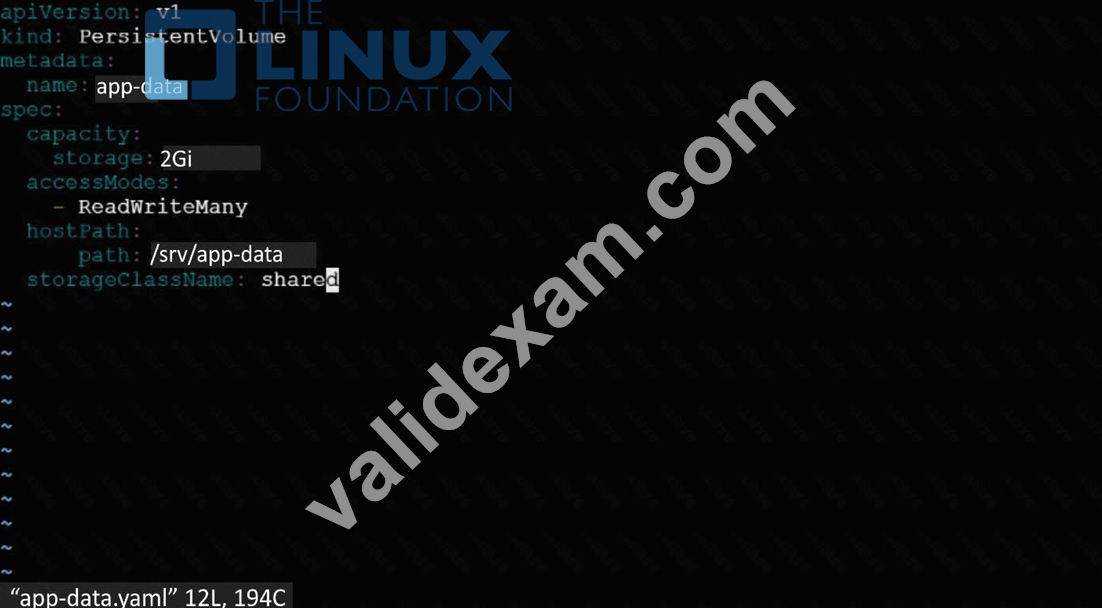
2. Save the file and create the persistent volume.
Image for post
3. View the persistent volume.
* Our persistent volume status is available meaning it is available and it has not been mounted yet. This status will change when we mount the persistentVolume to a persistentVolumeClaim.
PersistentVolumeClaim
In a real ecosystem, a system admin will create the PersistentVolume then a developer will create a PersistentVolumeClaim which will be referenced in a pod. A PersistentVolumeClaim is created by specifying the minimum size and the access mode they require from the persistentVolume.
Challenge
* Create a Persistent Volume Claim that requests the Persistent Volume we had created above. The claim should request 2Gi. Ensure that the Persistent Volume Claim has the same storageClassName as the persistentVolume you had previously created.
kind: PersistentVolumeapiVersion: v1metadata: name:
spec:
accessModes: - ReadWriteMany
requests: storage: 2Gi
storageClassName: shared
2. Save and create the pvc
njerry191@cloudshell:~ (extreme-clone-2654111)$ kubect1 create -f app-data.yaml persistentvolumeclaim/app-data created
3. View the pvc
Image for post
4. Let's see what has changed in the pv we had initially created.
Image for post
Our status has now changed from available to bound.
5. Create a new pod named myapp with image nginx that will be used to Mount the Persistent Volume Claim with the path /var/app/config.
Mounting a Claim
apiVersion: v1kind: Podmetadata: creationTimestamp: null name: app-dataspec: volumes: - name:congigpvc persistenVolumeClaim: claimName: app-data containers: - image: nginx name: app volumeMounts: - mountPath: "/srv/app-data " name: configpvc
NEW QUESTION 24
Create a PersistentVolumeClaim of at least 3Gi storage and access mode ReadWriteOnce and verify status is Bound
- A. vim task-pv-claim.yaml
apiVersion: v2
kind: PersistentVolumeClaim
metadata:
name: task-pv-claim
spec:
storageClassName: ""
accessModes:
- ReadWriteOnce
resources:
requests:
storage: 4Gi
kubectl apply -f task-pv-claim.yaml
//Verify
kubectl get pv
NAME CAPACITY ACCESS
MODES RECLAIM POLICY STATUS CLAIM
STORAGECLASS REASON AGE
task-pv-volume 4Gi RWO
Retain Bound default/task-pv-claim
6m16s
kubectl get pvc
NAME STATUS VOLUME
CAPACITY ACCESS MODES STORAGECLASS AGE
task-pv-claim Bound task-pv-volume
5Gi RWO 6s - B. vim task-pv-claim.yaml
apiVersion: v1
kind: PersistentVolumeClaim
metadata:
name: task-pv-claim
spec:
storageClassName: ""
accessModes:
- ReadWriteOnce
resources:
requests:
storage: 3Gi
kubectl apply -f task-pv-claim.yaml
//Verify
kubectl get pv
NAME CAPACITY ACCESS
MODES RECLAIM POLICY STATUS CLAIM
STORAGECLASS REASON AGE
task-pv-volume 5Gi RWO
Retain Bound default/task-pv-claim
6m16s
kubectl get pvc
NAME STATUS VOLUME
CAPACITY ACCESS MODES STORAGECLASS AGE
task-pv-claim Bound task-pv-volume
5Gi RWO 6s
Answer: B
NEW QUESTION 25
Configure the kubelet systemd-managed service, on the nodelabelled withname=wk8s-node-1, tolaunch a pod containing a singlecontainer of Image automatically. Any spec filesrequired should be placed in the/etc/kubernetes/manifests You canssh to theappropriate node using:
[student@node-1] $ sshwk8s-node-1
You can assume elevatedprivileges on the node with thefollowing command:
[student@wk8s-node-1] $ |sudo -i
Answer:
Explanation:
See the solution below.
Explanation
solution


NEW QUESTION 26
Undo the deployment with the previous version and verify
everything is Ok
Answer:
Explanation:
kubectl rollout undo deploy webapp kubectl rollout status deploy webapp kubectl get pods
NEW QUESTION 27
Create a snapshot of theetcdinstance running at , saving thesnapshot to the file path
/srv/data/etcd-snapshot.db.
The following TLScertificates/key are suppliedfor connecting to the server withetcdctl:
* CA certificate:/opt/KUCM00302/ca.crt
* Client certificate:/opt/KUCM00302/etcd-client.crt
* Client key:Topt/KUCM00302/etcd-client.key
Answer:
Explanation:
See the solution below.
Explanation
solution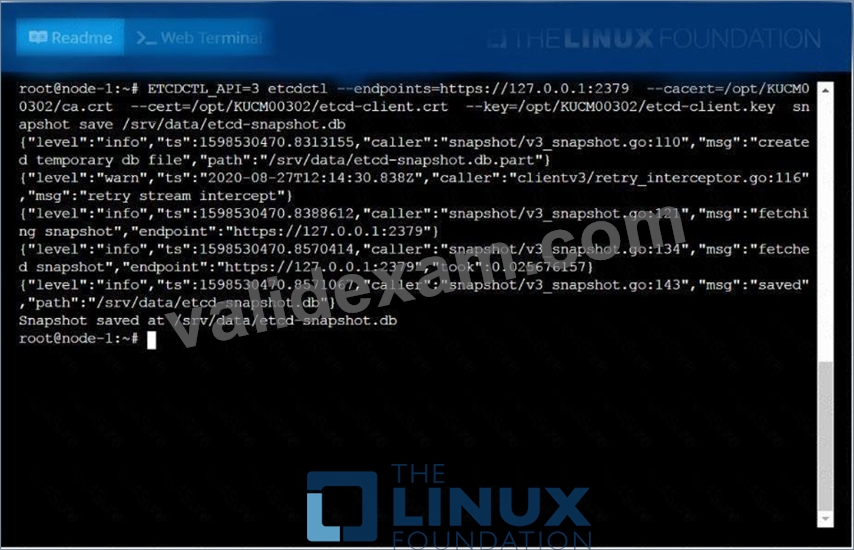
NEW QUESTION 28
Score: 4%
Task
Set the node named ek8s-node-1 as unavailable and reschedule all the pods running on it.
Answer:
Explanation:
See the solution below.
Explanation
SOLUTION:
[student@node-1] > ssh ek8s
kubectl cordon ek8s-node-1
kubectl drain ek8s-node-1 --delete-local-data --ignore-daemonsets --force
NEW QUESTION 29
Create a NetworkPolicy which denies all ingress traffic
- A. apiVersion: networking.k8s.io/v1
kind: NetworkPolicy
metadata:
name: default-deny
spec:
podSelector: {}
policyTypes:
- Ingress - B. apiVersion: networking.k8s.io/v1
kind: NetworkPolicy
metadata:
name: default-deny
spec:
podSelector: ()
policyTypes:
- Ingress
Answer: A
NEW QUESTION 30
Create a pod that echo "hello world" and then exists. Have the pod deleted automatically when it's completed
Answer:
Explanation:
See the solution below.
Explanation
kubectl run busybox --image=busybox -it --rm --restart=Never --
/bin/sh -c 'echo hello world'
kubectl get po # You shouldn't see pod with the name "busybox"
NEW QUESTION 31
Check logs of each container that "busyboxpod-{1,2,3}"
- A. kubectl logs busybox -c busybox-container-1
kubectl logs busybox -c busybox-container-3
kubectl logs busybox -c busybox-container-3 - B. kubectl logs busybox -c busybox-container-1
kubectl logs busybox -c busybox-container-2
kubectl logs busybox -c busybox-container-3
Answer: B
NEW QUESTION 32
Get IP address of the pod - "nginx-dev"
Answer:
Explanation:
See the solution below.
Explanation
Kubect1 get po -o wide
Using JsonPath
kubect1 get pods -o=jsonpath='{range
items[*]}{.metadata.name}{"\t"}{.status.podIP}{"\n"}{end}'
NEW QUESTION 33
What is the maximum number of samples that can be submitted to WildFire manually per day?
- A. 5,000
- B. 1,000
- C. 2,000
- D. 15,000
Answer: B
NEW QUESTION 34
Configure the kubelet systemd- managed service, on the node labelled with name=wk8s-node-1, to launch a pod containing a single container of Image httpd named webtool automatically. Any spec files required should be placed in the /etc/kubernetes/manifests directory on the node.
You can ssh to the appropriate node using:
[student@node-1] $ ssh wk8s-node-1
You can assume elevated privileges on the node with the following command:
[student@wk8s-node-1] $ | sudo -i
Answer:
Explanation:
See the solution below.
Explanation
solution
F:\Work\Data Entry Work\Data Entry\20200827\CKA\21 C.JPG
F:\Work\Data Entry Work\Data Entry\20200827\CKA\21 D.JPG
F:\Work\Data Entry Work\Data Entry\20200827\CKA\21 E.JPG
F:\Work\Data Entry Work\Data Entry\20200827\CKA\21 F.JPG
F:\Work\Data Entry Work\Data Entry\20200827\CKA\21 G.JPG
NEW QUESTION 35
......
CKA Practice Test Pdf Exam Material: https://www.validexam.com/CKA-latest-dumps.html
CKA Questions Pass on Your First Attempt Dumps for Kubernetes Administrator Certified: https://drive.google.com/open?id=1IfLLqmbUl0ta95vv62RW2C84H6B-Rotk