


[Aug-2023] PMI PMI-RMP Exam: Basic Questions With Answers
New 2023 Realistic Free PMI PMI-RMP Exam Dump Questions and Answer
PMI-RMP (PMI Risk Management Professional) Certification Exam is a globally recognized certification awarded by the Project Management Institute (PMI) to professionals who demonstrate expertise in the field of risk management. PMI Risk Management Professional certification is ideal for individuals who are responsible for identifying, analyzing, and managing risks in projects and organizations. The PMI-RMP certification exam tests candidates on their knowledge and skills related to risk management principles, concepts, and techniques. It is designed to validate the candidate's ability to assess and mitigate risk, and enhance project success.
NEW QUESTION # 69
A race director is planning a marathon with US$80,000 in upfront costs that will be offset by race fees. The remainder of the funds will be donated to a national charity. State law mandates that all money paid by the participants must be refunded if the race is cancelled for any reason.
Which of the following is the best example of a risk mitigation response?
- A. Let the runners know the race will be cancelled only in the event of an emergency.
- B. Purchase an insurance policy covering up to US$85,000 in losses, at a cost of US$5,000, in the event the race is cancelled.
- C. Inform the charity that they will receive no funds should the race be cancelled.
- D. Charge the runners an additional amount to cover the US$80,000.
Answer: B
NEW QUESTION # 70
As part of identifying the risk appetite of project stakeholders, the project manager must first identify the stakeholders. Which of the following inputs are used to identify project stakeholders?
- A. Project management plan, human resource plan, enterprise environmental factors, and organizational process assets
- B. Project charter, bid documents, enterprise environmental factors, and organizational process assets
- C. Project charter, management reserve, enterprise environmental factors, and organizational process assets
- D. Project charter, communications management plan, enterprise environmental factors, and organizational process assets
Answer: B
NEW QUESTION # 71 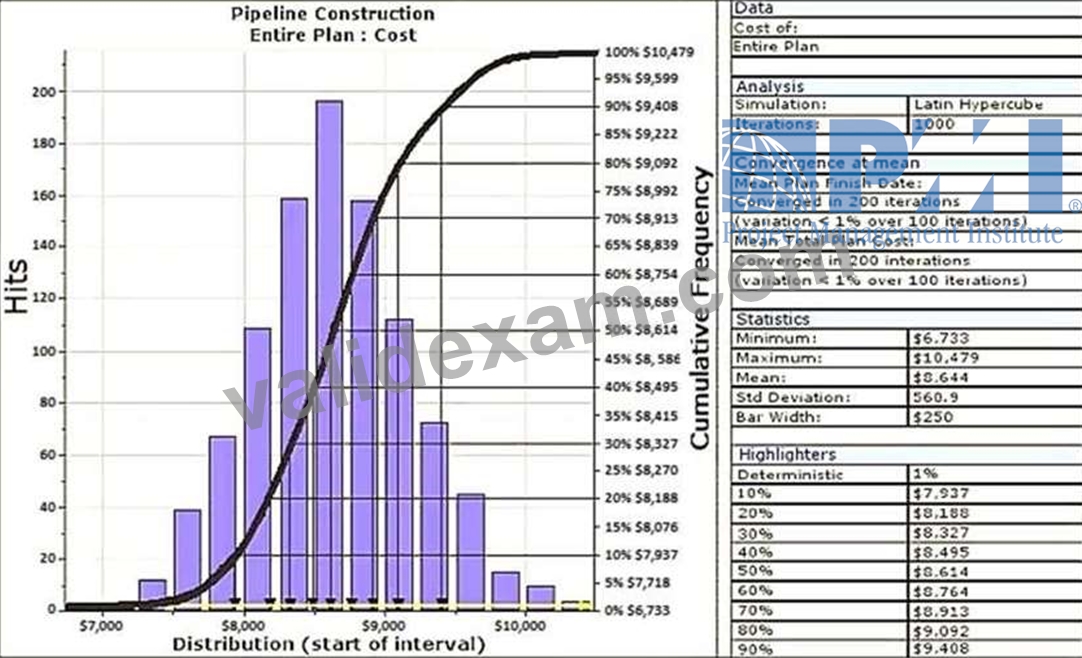
The project sponsor has asked the project manager how much more a P90 will cost. The sponsor has budgeted for a P40. The project values are in thousands.
How much additional funding would the sponsor need to budget for a P90?
- A. US$9,408,000
- B. US$913,000
- C. US$8,495,000
- D. US$794,000
Answer: B
NEW QUESTION # 72
Who is the most appropriate person to conduct a risk identification brainstorming session?
- A. Facilitator
- B. Project manager
- C. Project sponsor
- D. Subject matter expert
Answer: A
NEW QUESTION # 73
During which of the following processes, probability and impact matrix is prepared?
- A. Monitoring and Control Risks
- B. Perform Quantitative Risk Analysis
- C. Perform Qualitative Risk Analysis
- D. Plan Risk Responses
Answer: C
NEW QUESTION # 74
A risk manager assessed all project risks, and the team is now identifying common groupings of risks. What tool or technique is used to perform this risk assessment?
- A. Risk identification checklist
- B. Risk probability and impact assessment
- C. Risk breakdown structure (RBS)
- D. Risk register
Answer: C
NEW QUESTION # 75
There are seven risk responses, a project manager can use to address risk events. Which one of the following is a risk response that is appropriate for positive or negative risk events depending on the scenario in the project?
- A. Transference
- B. Avoidance
- C. Sharing
- D. Acceptance
Answer: D
Explanation:
Explanation
NEW QUESTION # 76
Jenny is the project manager for the NBT projects. She is working with the project team and several subject matter experts to perform the quantitative risk analysis process. During this process she and the project team uncover several risks events that were not previously identified. What should Jenny do with these risk events?
- A. The events should be entered into qualitative risk analysis.
- B. The events should be entered into the risk register.
- C. The events should continue on with quantitative risk analysis.
- D. The events should be determined if they need to be accepted or responded to.
Answer: B
NEW QUESTION # 77
A project manager has just been assigned to a new project. The project manager has been tasked by the project sponsor to ensure the project risks are closely managed. The project manager starts with developing the risk management plan.
What is the expected outcome of developing the risk management plan?
- A. Documenting the communication strategy for risks throughout the project.
- B. Being able to monitor and control risks throughout the project.
- C. Defining how risk management will be executed throughout the project.
- D. Having the ability to identify risks throughout the project.
Answer: C
Explanation:
Explanation
The expected outcome of developing the risk management plan is to define how risk management activities will be executed throughout the project. This includes the processes, tools, and techniques that will be used to identify, assess, and manage risks.
NEW QUESTION # 78
You work as a project manager for BlueWell Inc. You are preparing for the risk identification process. You will need to involve several of the project's key stakeholders to help you identify and communicate the identified risk events. You will also need several documents to help you and the stakeholders identify the risk events.
Which one of the following is NOT a document that will help you identify and communicate risks within the project?
- A. Activity duration estimates
- B. Activity cost estimates
- C. Stakeholder register
- D. Risk register
Answer: D
NEW QUESTION # 79
A regional vendor for custom manufactured steel oil derricks, is awarded a contract to design, manufacture, and install 40 offshore oil platforms. Installation of these derricks requires precision placement and stable seas for the transport and installation ships to property install the deep water structure. There are several schedule and cost incentives for early completion, and the project manager asks the project risk coordinator to perform an analysis, which will predict the probability of meeting the incentive dates. While researching methods that could be used for performing this analysis, the risk manager realizes that there are readily available spreadsheets within the organization. The risk manager is considering performing a Method of Moments (PERT) analysis with software already owned, or the other option is to buy a commercial risk analysis software suite that will perform Latin Hypercube Monte Carlo simulations at a cost of US$975.
What would be the best analytical option for this probability assessment?
- A. Schedule based Method of Moments analysis is a time proven, highly accurate method for schedule risk and is not impacted by Monte Carlo simulation's limitation of summation modeling where only addition and subtraction of uncertain values are used.
- B. Because a schedule risk assessment involves multiplication and division of schedule durations against specific risk events, a spreadsheet and using a Method of Moments analysis is the best option.
- C. Since a schedule risk assessment involves multiplication and division of schedule durations against specific risk events, the Monte Carlo simulation software is the best option.
- D. The commercial product that performs the Monte Carlo simulations is the best option, because a schedule risk assessment involves summation of uncertainties added or subtracted from or to schedule dates.
Answer: D
NEW QUESTION # 80
You are the project manager of the GHY Project for your company. You need to complete a project management process that will be on the lookout for new risks, changing risks, and risks that are now outdated. Which project management process is responsible for these actions?
- A. Risk analysis
- B. Risk identification
- C. Risk planning
- D. Risk monitoring and controlling
Answer: D
NEW QUESTION # 81
A six-month, US$1,2 million project is two months completed. The project has 3 high, 6 medium, and 2 low risks, with a 10% reserve for known risks, and a 5% reserve for unknown risks. Most of the project's reserves have not been spent. The risk manager, who is also the project schedule manager, establishes monthly risk management reviews to evaluate performance. So far, the project has missed 50% of the planned risk mitigation milestones.
Based on this project data, what technique should the risk manager recommend to improve the risk management process?
- A. Increase the risk manager's position to a full-time position and acquire a dedicated project schedule lead.
- B. Perform a variance analysis and potentially allocate more reserves to improve risk mitigation.
- C. Adjust project risk thresholds to increase the number of residual risks on the project.
- D. Increase the frequency of risk status meetings and update the risk management plan.
Answer: A
NEW QUESTION # 82
Holly is the project manager of the NSS Project for her company. She is discussing some of the project risks and the issues that have happened in the project. Holly has faxed the status report to her project client for their review. Based on the standard communication model, which component in this scenario is the decoder?
- A. Holly
- B. Project customer
- C. Telephone wire
- D. Project customer's fax machine
Answer: D
NEW QUESTION # 83
A supplier Is delayed in delivering fuel for a project. The project manager anticipated this risk and is requesting fuel from another supplier. When speaking with the other supplier, a new risk appears because fulfilling the order will cause delays with several other projects.
After performing a detailed analysis, what should the risk manager do?
- A. Execute the approved risk response plan.
- B. Negotiate with the supplier to resolve the problem.
- C. Assign a team member to update the issue leg.
- D. Escalate the problem to the project sponsors.
Answer: A
Explanation:
Explanation
The risk manager should execute the approved risk response plan, which should have been developed during the risk management process. This plan outlines the actions to be taken in response to specific risks and ensures that the project team is prepared to address potential issues.
NEW QUESTION # 84
The project manager of a project in trouble actively participates in a project risk assessment. After the assessment is complete, the project manager receives the final results.
What is the best recommended action to be taken from this point onward?
- A. Use the assessment results in the day-to-day management of project risks.
- B. Use the assessment results to review the project hand over plan to operations.
- C. Schedule a meeting with the project sponsor and discuss the assessment results.
- D. Schedule a meeting and present the assessment results.
Answer: D
NEW QUESTION # 85
During project planning, a risk is identified for which the risk manager has defined a mitigationstrategy. Later during project execution, this risk still leaves substantial residual risk.
What should the risk manager do to handle this situation?
- A. Revisit this risk in the risk register and redefine the mitigation strategy.
- B. Mark this new risk as an extremely high priority and inform all stakeholders.
- C. Ask the project sponsor for more budget to deal with this risk.
- D. Activate the contingency plan to handle this risk during execution.
Answer: A
Explanation:
Explanation
If a risk still leaves substantial residual risk after implementing the mitigation strategy, the risk manager should revisit the risk register and redefine the mitigation strategy to reduce the residual risk to an acceptable level.
NEW QUESTION # 86
Which of the following templates may be included in the risk management plan?
- A. Formal brainstorming list
- B. Formal structure for a risk statement
- C. Structure for a SWOT diagram
- D. Work performance report
Answer: B
NEW QUESTION # 87
Frank is the project manager of the NHQ project for his company. Frank is working with the project team, key stakeholders, and several subject matter experts on risks dealing with the new materials in the project.
Frank wants to utilize a risk analysis method that will help the team to make decisions in the presence of the current uncertainty surrounding the new materials. Which risk analysis approach can Frank use to create an approach to make decisions in the presence of uncertainty?
- A. Delphi Technique
- B. Qualitative risk analysis process
- C. Monte Carlo Technique
- D. Quantitative risk analysis process
Answer: D
NEW QUESTION # 88
Which of the following would a proactive risk manager do during the Monitoring and Controlling Process?
- A. Develop risk responses, create risk management plan, and stay alert for risk events.
- B. Review identified risks, stay alert for risk events, and remind team members to keep the risk manager informed about risk triggers.
- C. Update the lessons learned documents, develop risk responses, and create the risk management plan.
- D. Review lessons learned document to identify risks, quantity risks, and lower impact ratings.
Answer: B
NEW QUESTION # 89
A risk manager manages risks in a construction project. A stakeholder mentions that if there is less than a 50% chance of rain, construction should continue. Another stakeholder says that if there is less than a 60% chance of rain, construction should continue.
What should the risk manager do next to find out the correct limit?
- A. Perform a sensitivity analysis of the risk
- B. Use industry standard risk thresholds
- C. Find out the stakeholders' risk appetite
- D. Review the agreed-upon risk tolerance
Answer: D
Explanation:
Explanation
The risk manager should review the agreed-upon risk tolerance to determine the correct limit for continuing construction based on the chance of rain. Risk tolerance is the level of risk an organization is willing to accept and should be established during the risk management planning process.
NEW QUESTION # 90
You are the project manager of the CUL project in your organization. You and the project team are assessing the risk events and creating a probability and impact matrix for the identified risks. Which one of the following statements best describes the requirements for the data type used in qualitative risk analysis?
- A. A qualitative risk analysis required unbiased stakeholders with biased risk tolerances.
- B. A qualitative risk analysis requires accurate and unbiased data if it is to be credible.
- C. A qualitative risk analysis requires fast and simple data to complete the analysis.
- D. A qualitative risk analysis encourages biased data to reveal risk tolerances.
Answer: B
NEW QUESTION # 91
Three months into a program, multiple workstreams are showing issues. At this point, the program manager requires that a risk impact assessment be conducted.
What will help calculate the impact?
- A. Risk treatment
- B. Risk identification
- C. Risk evaluation
- D. Risk analysis
Answer: D
Explanation:
Explanation
Risk impact assessment involves calculating the impact of identified risks. Risk analysis is the process of examining, estimating, and evaluating the impact of risks, which helps in calculating the impact (Reference:
PMBOK Guide, 6th Edition, p. 417)
NEW QUESTION # 92
Holly is the project manager of the NSS Project for her company. She is discussing some of the project risks and the issues that have happened in the project. Holly has faxed the status report to her project client for their review. Based on the standard communication model, which component in this scenario is the decoder?
- A. Holly
- B. Project customer
- C. Telephone wire
- D. Project customer's fax machine
Answer: D
NEW QUESTION # 93
During the execution of a multi-million dollar project, the project manager learns of the theft of important installation materials at one of the most time-critical sites. The project manager contacts the risk manager to discuss further steps, based on the risk register and the defined risk strategy for the risk of theft. However, the risk manager clarifies that the risk of theft was not identified in the risk management process.
What should the project manager do next?
- A. Update the project schedule and inform the stakeholders about the project schedule delay.
- B. Make the risk manager responsible for the damage caused by the missing risk strategy for theft and update the project schedule.
- C. Deal with the issue and instruct the risk manager to include the risk of theft in the issue log.
- D. Instruct the risk manager to transfer the risk of theft to an insurance company and capture the experience in the lessons learned.
Answer: C
Explanation:
Explanation
NEW QUESTION # 94
......
To be eligible for the PMI-RMP exam, candidates must have a minimum of three years of professional experience in risk management and 40 hours of risk management education. Candidates must also have a high school diploma or global equivalent. However, individuals with a bachelor's or master's degree may be eligible for a reduced number of required hours of experience and education.
Guaranteed Success in Project Management Professional PMI-RMP Exam Dumps: https://www.validexam.com/PMI-RMP-latest-dumps.html
PMI-RMP Practice Test Engine: Try These 117 Exam Questions: https://drive.google.com/open?id=1cdliEbZhBcXE7RzZvFMY6KKBdprzUCaN