


[Feb 24, 2026] Powerful C1000-130 PDF Dumps for C1000-130 Questions
Authentic C1000-130 Dumps - Free PDF Questions to Pass
IBM C1000-130 exam is intended for IT professionals who are responsible for installing, configuring, and administering the IBM Cloud Pak for Integration platform. C1000-130 exam is relevant for individuals who work in roles such as system administrators, integration architects, and developers. Passing C1000-130 exam demonstrates that the candidate has the knowledge and skills to work with the IBM Cloud Pak for Integration platform and can help their organization achieve its integration objectives.
NEW QUESTION # 65
An administrator is looking to install Cloud Pak for Integration on an OpenShift cluster. What is the result of executing the following?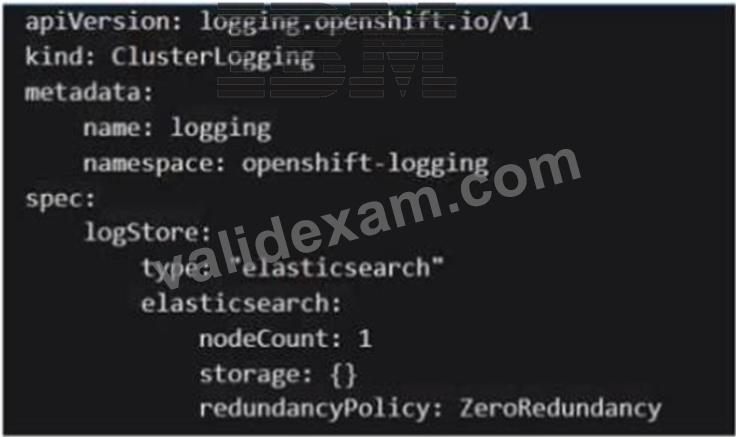
- A. A single node ElasticSearch cluster with no persistent storage.
- B. A single infrastructure node with persisted ElasticSearch.
- C. A single node ElasticSearch cluster with default persistent storage.
- D. A single node ElasticSearch cluster which auto scales when redundancyPolicy is set to MultiRedundancy.
Answer: A
Explanation:
The given YAML configuration is for ClusterLogging in an OpenShift environment, which is used for centralized logging. The key part of the specification that determines the behavior of Elasticsearch is:
logStore:
type: "elasticsearch"
elasticsearch:
nodeCount: 1
storage: {}
redundancyPolicy: ZeroRedundancy
Analysis of Key Fields:
nodeCount: 1
This means the Elasticsearch cluster will consist of only one node (single-node deployment).
storage: {}
The empty storage field implies no persistent storage is configured.
This means that if the pod is deleted or restarted, all stored logs will be lost.
redundancyPolicy: ZeroRedundancy
ZeroRedundancy means there is no data replication, making the system vulnerable to data loss if the pod crashes.
In contrast, a redundancy policy like MultiRedundancy ensures high availability by replicating data across multiple nodes, but that is not the case here.
Evaluating Answer Choices:
Option
Explanation:
Correct?
A . A single node ElasticSearch cluster with default persistent storage.
Incorrect, because storage: {} means no persistent storage is configured.
❌
B . A single infrastructure node with persisted ElasticSearch.
Incorrect, as this is not configuring an infrastructure node, and storage is not persistent.
❌
C . A single node ElasticSearch cluster which auto scales when redundancyPolicy is set to MultiRedundancy.
Incorrect, because setting MultiRedundancy does not automatically enable auto-scaling. Scaling needs manual intervention or Horizontal Pod Autoscaler (HPA).
❌
D . A single node ElasticSearch cluster with no persistent storage.
Correct, because nodeCount: 1 creates a single node, and storage: {} ensures no persistent storage.
✅
Final answer:
✅ D. A single node ElasticSearch cluster with no persistent storage.
IBM Cloud Pak for Integration (CP4I) v2021.2 Administration Reference:
IBM CP4I Logging and Monitoring Documentation
Red Hat OpenShift Logging Documentation
Elasticsearch Redundancy Policies in OpenShift Logging
NEW QUESTION # 66
What is the purpose of the Automation Assets Deployment capability?
- A. It is a streaming platform that enables organization and management of data from many different sources.
- B. It allows the user to store, manage, retrieve, and search integration assets from within the Cloud Pak.
- C. It allows the user to only store and manage integration assets from within the Cloud Pak
- D. It is a streaming platform that enables organization and management of data but only from a single source.
Answer: B
Explanation:
In IBM Cloud Pak for Integration (CP4I) v2021.2, the Automation Assets Deployment capability is designed to help users efficiently manage integration assets within the Cloud Pak environment. This capability provides a centralized repository where users can store, manage, retrieve, and search for integration assets that are essential for automation and integration processes.
Option A is incorrect: The Automation Assets Deployment feature is not a streaming platform for managing data from multiple sources. Streaming platforms, such as IBM Event Streams, are used for real-time data ingestion and processing.
Option B is incorrect: Similar to Option A, this feature does not focus on data streaming or management from a single source but rather on handling integration assets.
Option C is correct: The Automation Assets Deployment capability provides a comprehensive solution for storing, managing, retrieving, and searching integration-related assets within IBM Cloud Pak for Integration. It enables organizations to reuse and efficiently deploy integration components across different services.
Option D is incorrect: While this capability allows for storing and managing assets, it also provides retrieval and search functionality, making Option C the more accurate choice.
IBM Cloud Pak for Integration (CP4I) v2021.2 Administration Reference:
IBM Cloud Pak for Integration Documentation
IBM Cloud Pak for Integration Automation Assets Overview
IBM Knowledge Center - Managing Automation Assets
NEW QUESTION # 67
An administrator has to implement high availability for various components of a Cloud Pak for Integration installation. Which two statements are true about the options available?
- A. Queue Manager (MQ) uses Replicated Data Queue Manager (RDQM).
- B. AppConnect can use a mix of mechanisms - like failover for stateful workloads and active/active deployments for stateless workloads
- C. DataPower gateway uses a Quorum mechanism where a global load balancer uses quorum algorithm to choose the active instance.
- D. Platform Navigator uses an Active/Active deployment, where the primary handles all the traffic and in case of failure of the primary, the load balancer will then route the traffic to the secondary.
- E. API management uses a quorum mechanism where components are deployed on a minimum of three failure domains.
Answer: C,D
NEW QUESTION # 68
Which diagnostic information must be gathered and provided to IBM Support for troubleshooting the Cloud Pak for Integration instance?
- A. Standard OpenShift Container Platform logs.
- B. Integration tracing activity reports.
- C. Platform Navigator event logs.
- D. Cloud Pak For Integration activity logs.
Answer: D
NEW QUESTION # 69
Which configuration file contains the CA domain specified for the cluster?
- A. config.yaml
- B. domain.config
- C. config.json
- D. ca.config
Answer: A
NEW QUESTION # 70
When using the Operations Dashboard, which of the following is supported for encryption of data at rest?
- A. base64
- B. AES128
- C. Portworx
- D. NFS
Answer: C
Explanation:
The Operations Dashboard in IBM Cloud Pak for Integration (CP4I) v2021.2 is used for monitoring and managing integration components. When securing data at rest, the supported encryption method in CP4I includes Portworx, which provides enterprise-grade storage and encryption solutions.
Why Option B (Portworx) is Correct:
Portworx is a Kubernetes-native storage solution that supports encryption of data at rest.
It enables persistent storage for OpenShift workloads, including Cloud Pak for Integration components.
Portworx provides AES-256 encryption, ensuring that data at rest remains secure.
It allows for role-based access control (RBAC) and Key Management System (KMS) integration for secure key handling.
Explanation of Incorrect Answers:
A . AES128 → Incorrect
While AES encryption is used for data protection, AES128 is not explicitly mentioned as the standard for Operations Dashboard storage encryption.
AES-256 is the preferred encryption method when using Portworx or IBM-provided storage solutions.
C . base64 → Incorrect
Base64 is an encoding scheme, not an encryption method.
It does not provide security for data at rest, as base64-encoded data can be easily decoded.
D . NFS → Incorrect
Network File System (NFS) does not inherently provide encryption for data at rest.
NFS can be used for storage, but additional encryption mechanisms are needed for securing data at rest.
IBM Cloud Pak for Integration (CP4I) v2021.2 Administration Reference:
IBM Cloud Pak for Integration Security Best Practices
Portworx Data Encryption Documentation
IBM Cloud Pak for Integration Storage Considerations
Red Hat OpenShift and Portworx Integration
https://www.ibm.com/docs/en/cloud-paks/cp-integration/2020.3?topic=configuration-installation
NEW QUESTION # 71
What is one way to obtain the OAuth secret and register a workload to Identity and Access Management?
- A. Through the Red Hat Marketplace.
- B. Using the OperandConfig API file
- C. Using a Custom Resource Definition (CRD) file.
- D. Extracting the ibm-entitlement-key secret.
Answer: B
Explanation:
In IBM Cloud Pak for Integration (CP4I) v2021.2, workloads requiring authentication with Identity and Access Management (IAM) need an OAuth secret for secure access. One way to obtain this secret and register a workload is through the OperandConfig API file.
Why Option D is Correct:
OperandConfig API is used in Cloud Pak for Integration to configure operands (software components).
It provides a mechanism to retrieve secrets, including the OAuth secret necessary for authentication with IBM IAM.
The OAuth secret is stored in a Kubernetes secret, and OperandConfig API helps configure and retrieve it dynamically for a registered workload.
Explanation of Incorrect Answers:
A . Extracting the ibm-entitlement-key secret. → Incorrect
The ibm-entitlement-key is used for entitlement verification when pulling IBM container images from IBM Container Registry.
It is not related to OAuth authentication or IAM registration.
B . Through the Red Hat Marketplace. → Incorrect
The Red Hat Marketplace is for purchasing and deploying OpenShift-based applications but does not provide OAuth secrets for IAM authentication in Cloud Pak for Integration.
C . Using a Custom Resource Definition (CRD) file. → Incorrect
CRDs define Kubernetes API extensions, but they do not directly handle OAuth secret retrieval for IAM registration.
The OperandConfig API is specifically designed for managing operand configurations, including authentication details.
IBM Cloud Pak for Integration (CP4I) v2021.2 Administration Reference:
IBM Cloud Pak for Integration Identity and Access Management
IBM OperandConfig API Documentation
IBM Cloud Pak for Integration Security Configuration
NEW QUESTION # 72
An administrator has configured OpenShift Container Platform (OCP) log forwarding to external third-party systems. What is expected behavior when the external logging aggregator becomes unavailable and the collected logs buffer size has been completely filled?
- A. OCP rotates the logs and deletes them.
- B. OCP store the logs in a temporary PVC.
- C. The Fluentd daemon is forced to stop.
- D. OCP extends the buffer size and resumes logs collection.
Answer: D
NEW QUESTION # 73
What is the effect of creating a second medium size profile?
- A. The second profile will be configured with a medium size.
- B. The second profile will be configured with a large size.
- C. The first profile will be re-configured with a medium size.
- D. The first profile will be replaced by the second profile.
Answer: A
NEW QUESTION # 74
Which statement is true about the Confluent Platform capability for the IBM Cloud Pak for Integration?
- A. It provides APIs to discover applications, platforms, and infrastructure in the environment.
- B. It provides an event-streaming platform to organize and manage data from many different sources with one reliable, high performance system.
- C. It provides a capability that allows user to store, manage, and retrieve integration assets in IBM Cloud Pak for Integration.
- D. It provides the ability to trace transactions through IBM Cloud Pak for Integration.
Answer: C
NEW QUESTION # 75
An administrator is installing Cloud Pak for Integration onto an OpenShift cluster that does not have access to the internet.
How do they provide their ibm-entitlement-key when mirroring images to a portable registry?
- A. The administrator sets the key with "export ENTITLEMENTKEY" and then uses the
"cloudPakOfflmelnstaller -mirror-images" script to mirror the images - B. The administrator uses a cloudctl case command to configure credentials for registries which require authentication before mirroring the images.
- C. The administrator adds the entitlement-key to the properties file SHOME/.airgap/registries on the Bastion Host.
- D. The ibm-entitlement-key is added as a docker-registry secret onto the OpenShift cluster.
Answer: C
NEW QUESTION # 76
Which two App Connect resources enable callable flows to be processed between an integration solution in a cluster and an integration server in an on-premise system?
- A. Routing agent
- B. Connectivity agent
- C. Switch server
- D. Sync server
- E. Kafka sync
Answer: B,C
NEW QUESTION # 77
An API Conned administrator runs the command shown below: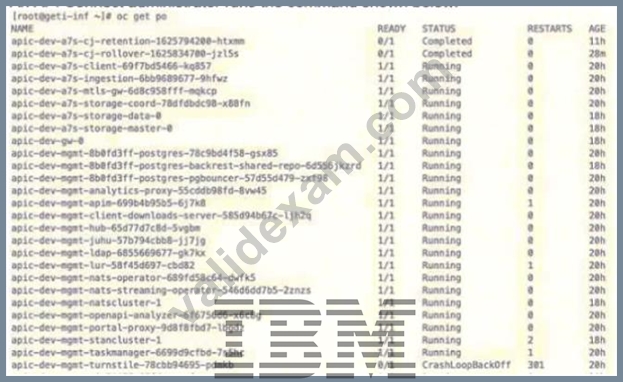
Given the output of the command, what is the state of the API Connect components?
- A. Developer Portal sites will be unresponsive.
- B. Automated API behavior testing has failed.
- C. New API calls will be rejected by the gateway service.
- D. The Analytics subsystem cannot retain historical data.
Answer: A
Explanation:
The command executed is:
sh
CopyEdit
oc get po
This command lists the pods running in an OpenShift (OCP) cluster where IBM API Connect is deployed.
Key Observations from the Output:
Most API Connect management components (apic-dev-mgmt-xxx) are in a Running state, which indicates that the core API Connect system is operational.
The apic-dev-mgmt-turnstile pod is in a CrashLoopBackOff state, with 301 restarts, indicating that this component has repeatedly failed to start properly.
Understanding the Turnstile Component:
The Turnstile pod is a critical component of the IBM API Connect Developer Portal.
It manages authentication and access control for the Developer Portal, ensuring that API consumers can access the portal and manage API subscriptions.
When Turnstile is failing, the Developer Portal becomes unresponsive because authentication requests cannot be processed.
Why Answer B is Correct?
Since the Turnstile pod is failing, the Developer Portal will not function properly, preventing users from accessing API documentation and managing API subscriptions.
API providers and consumers will not be able to log in or interact with the Developer Portal.
Explanation of Incorrect Answers:
A . The Analytics subsystem cannot retain historical data. → Incorrect
The Analytics-related pods (e.g., apic-dev-analytics-xxx) are in a Running state.
If the Analytics component were failing, metrics collection and historical API call data would be impacted, but this is not indicated in the output.
C . Automated API behavior testing has failed. → Incorrect
There is no evidence in the pod list that API testing-related components (such as test clients or monitoring tools) have failed.
D . New API calls will be rejected by the gateway service. → Incorrect
The gateway service is not shown as failing in the provided output.
API traffic flows through the Gateway pods (typically apic-gateway-xxx), and they appear to be running fine.
If gateway-related pods were failing, API call processing would be affected, but that is not the case here.
IBM Cloud Pak for Integration (CP4I) v2021.2 Administration Reference:
IBM API Connect Deployment on OpenShift
Troubleshooting Developer Portal Issues
Understanding API Connect Components
OpenShift Troubleshooting Pods
NEW QUESTION # 78
When using the Platform Navigator, what permission is required to add users and user groups?
- A. Super-user
- B. root
- C. User
- D. Administrator
Answer: D
Explanation:
Explanation
https://www.ibm.com/docs/en/cloud-paks/cp-integration/2021.2?topic=administration-adding-users-platform-nav
NEW QUESTION # 79
Which capability describes and catalogs the APIs of Kafka event sources and socializes those APIs with application developers?
- A. Event Endpoint Management
- B. API Endpoint Management
- C. REST Endpoint Management
- D. Gateway Endpoint Management
Answer: A
Explanation:
Explanation
https://www.ibm.com/docs/en/cloud-paks/cp-integration/2021.3?topic=socializing-your-kafka-event-sources
NEW QUESTION # 80
What is the default time period for the data retrieved by the License Service?
- A. 90 days.
- B. 60 days.
- C. The full period from the deployment.
- D. 30 days.
Answer: A
Explanation:
In IBM Cloud Pak for Integration (CP4I) v2021.2, the IBM License Service collects and retains license usage data for a default period of 90 days. This data is crucial for auditing and compliance, ensuring that software usage aligns with licensing agreements.
Key Details About the IBM License Service Data Retention:
The IBM License Service continuously collects and stores licensing data.
By default, it retains data for 90 days before older data is automatically removed.
Users can query and retrieve usage reports from this 90-day period.
The License Service supports regulatory compliance by ensuring transparent tracking of software usage.
Why Not the Other Options?
B . The full period from the deployment - Incorrect. The License Service does not retain data indefinitely; it follows a rolling 90-day retention policy.
C . 30 days - Incorrect. The default retention period is longer than 30 days.
D . 60 days - Incorrect. The default is 90 days, not 60.
IBM Cloud Pak for Integration (CP4I) v2021.2 Administration Reference
IBM License Service Documentation
IBM Cloud Pak for Integration v2021.2 - Licensing Guide
IBM Support - License Service Data Retention Policy
NEW QUESTION # 81
In the Operations Dashboard, which configurable value can be set by the ad-ministrator to determine the percentage of traces that are sampled, collected, and stored?
- A. Sampling context.
- B. Sampling policy.
- C. Trace context.
- D. Tracing policy.
Answer: B
NEW QUESTION # 82
An administrator has been given an OpenShift Cluster to install Cloud Pak for Integration.
What can the administrator use to determine if the infrastructure pre-requisites are met by the cluster?
- A. Use the oc Use the oc describe nodes command to dump the node capacity and utilization statistics for all the nodes.
- B. Use the adm top nodes command to obtain the capacity and utilization statistics of memory and compute of the nodes.
- C. Use the oc get nodes -o wide command to obtain the capacity and utilization statistics of memory and compute of the nodes.
- D. Use the oc cluster status command to dump the node capacity and utilization statistics for all the nodes.
Answer: B
NEW QUESTION # 83
Select all that apply
What is the correct sequence of steps of how a multi-instance queue manager failover occurs?
Answer:
Explanation: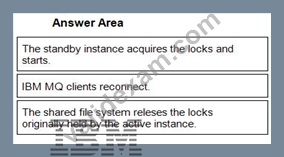
1 - The standby instance acquires the locks and starts.
2 - IBM MQ clients reconnect.
3 - The shared file system releses the locks originally held by the active instance.
NEW QUESTION # 84
Which option should an administrator choose if they need to run Cloud Pak for Integration (CP4I) on AWS but do not want to have to manage the OpenShift layer themselves?
- A. Deploy CP4I onto AWS ROSA.
- B. Use the "CP4I Quick Start on AWS" to deploy.
- C. Use Inslaller-provisioned-lnfrastructure to deploy OCP and CP4I onto EC2.
- D. Using the Terraform scripts for provisioning CP4I and OpenShift which are available on IBM's Github.
Answer: A
Explanation:
When deploying IBM Cloud Pak for Integration (CP4I) v2021.2 on AWS, an administrator has multiple options for managing the OpenShift layer. However, if the goal is to avoid managing OpenShift manually, the best approach is to deploy CP4I onto AWS ROSA (Red Hat OpenShift Service on AWS).
Why is AWS ROSA the Best Choice?
Managed OpenShift: ROSA is a fully managed OpenShift service, meaning AWS and Red Hat handle the deployment, updates, patching, and infrastructure maintenance of OpenShift.
Simplified Deployment: Administrators can directly deploy CP4I on ROSA without worrying about installing and maintaining OpenShift on AWS manually.
IBM Support: IBM Cloud Pak solutions, including CP4I, are certified to run on ROSA, ensuring compatibility and optimized performance.
Integration with AWS Services: ROSA allows seamless integration with AWS-native services like S3, RDS, and IAM for authentication and storage.
Why Not the Other Options?
B . Installer-provisioned Infrastructure on EC2 - This requires manual setup of OpenShift on AWS EC2 instances, increasing operational overhead.
C . CP4I Quick Start on AWS - IBM provides a Quick Start guide for deploying CP4I, but it assumes you are managing OpenShift yourself. This does not eliminate OpenShift management.
D . Terraform scripts from IBM's GitHub - These scripts help automate provisioning but still require the administrator to manage OpenShift themselves.
Thus, for a fully managed OpenShift solution on AWS, AWS ROSA is the best option.
IBM Cloud Pak for Integration (CP4I) v2021.2 Administration Reference:
IBM Cloud Pak for Integration Documentation
IBM Cloud Pak for Integration on AWS ROSA
Deploying Cloud Pak for Integration on AWS
Red Hat OpenShift Service on AWS (ROSA) Overview
NEW QUESTION # 85
What is the purpose of the Automation Assets Deployment capability?
- A. It is a streaming platform that enables organization and management of data from many different sources.
- B. It allows the user to store, manage, retrieve, and search integration assets from within the Cloud Pak.
- C. It allows the user to only store and manage integration assets from within the Cloud Pak
- D. It is a streaming platform that enables organization and management of data but only from a single source.
Answer: A
NEW QUESTION # 86
......
Guaranteed Accomplishment with Newest Feb-2026 FREE: https://www.validexam.com/C1000-130-latest-dumps.html
Use Valid New Free C1000-130 Exam Dumps & Answers: https://drive.google.com/open?id=1KnKr9rPdPtbe_c5wMwmkFtA_iy-lHx0w